
Table of Contents
- Why Schools Need an Emergency Restroom Trailer
- Temporary Restroom Capacity Planning for Schools
- Top Emergency Restroom Trailers for Schools in 2026
- ADA Compliant Restroom Trailer Rental: What Schools Must Know
- Key Features to Prioritize for School Sanitation
- Integrating Restroom Trailers Into Your School Safety Plan
- Cost-Benefit Analysis for School Districts
- Frequently Asked Questions
Last Updated: August 27, 2026
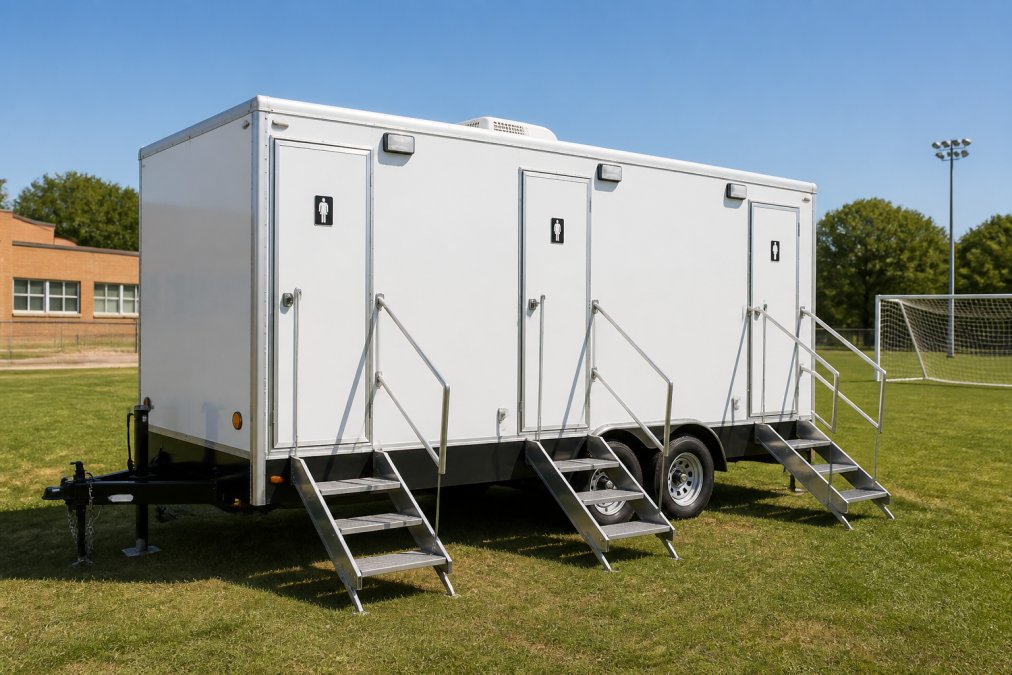
Schools face a sanitation crisis more often than most administrators expect. According to Nexdigm’s USA Portable Toilet Rental Market Outlook to 2030, the portable toilet rental market is valued at $2.8 billion in 2024 and growing at 7% annually, driven heavily by demand from educational institutions, construction, and emergency response. When a pipe bursts, a renovation overruns its schedule, or a natural disaster knocks out plumbing, school administrators need a solution that works within hours, not days. At Royal Thrones, we’ve helped facility managers source the right emergency restroom trailer for schools, and this guide breaks down exactly what to look for, how many stations you need, and which trailer configurations actually perform under pressure.
Quick Picks:
- Best Overall: Royal Thrones ADA-Compliant Restroom Trailer, climate-controlled, ADA-accessible, 24-hour service
Why Schools Need an Emergency Restroom Trailer
Plumbing failures in school buildings are more disruptive than any other infrastructure problem. State health codes require accessible, functioning sanitation facilities as a condition of occupancy. Without it, the school day ends.
Emergency restroom trailer demand falls into three categories: planned renovations where restroom wings are taken offline for weeks or months; unplanned failures such as burst pipes or sewage backups; and disaster response following flooding or severe weather that compromises plumbing infrastructure.
A common mistake is waiting until failure is confirmed before calling a rental provider. The smarter move is pre-identifying a provider and understanding your site’s utility access points before an emergency happens. Rapid deployment depends on knowing your site in advance.
According to Dataintelo’s Portable Restroom Trailer Market Research Report 2034, the global portable restroom trailer market was valued at $1.8 billion in 2025 and is projected to reach $3.1 billion by 2034, with North America accounting for approximately 44.7% of total revenues. That growth is driven by mounting regulatory pressure to provide accessible and sanitary temporary restroom facilities.
Temporary Restroom Capacity Planning for Schools
Getting capacity wrong costs money or creates a hygiene problem. Too few stations and you have lines that disrupt class schedules. Too many and you’ve over-spent the budget.
How Many Stations Does Your School Actually Need?
The standard industry benchmark for temporary sanitation is one toilet station per 50 people for events of up to 8 hours. For a full school day with continuous use, most sanitation professionals recommend one station per 35-40 students to account for peak-period surges during passing periods.
Use this planning table as a starting point:
| School Population | Recommended Stations | Suggested Configuration |
|---|---|---|
| Up to 150 students | 4 stations | 1 ADA unit + 3 standard stalls |
| 150-300 students | 6-8 stations | 1 ADA unit + 5-7 standard stalls |
| 300-500 students | 10-12 stations | 2 ADA units + 8-10 standard stalls |
| 500+ students | 14+ stations | Multiple trailers, staggered servicing |
These figures assume separate men’s and women’s facilities. If you’re deploying a single unisex configuration, reduce the per-station capacity estimate by roughly 20% to account for longer average occupancy times.
If your school has a high proportion of students with mobility impairments or uses wheelchairs, plan for at least one ADA-compliant unit per 100 students rather than the standard one-per-trailer minimum. ADA accessibility directly affects whether some students can use the facilities at all.
Short-Term vs. Extended Rental Timelines
Short-term rentals covering a weekend or a few days differ significantly from month-long deployments in both logistics and cost structure. According to 2026 Restroom Trailer(/8-station-restrooms-2/) Rental Cost Guide | basic 2-station restroom trailer runs $2,799 to $3,399 for a Friday-through-Monday rental, while long-term rentals of 28 days start at $5,299 and can reach $15,999 for larger units.
For school renovations that run 4-12 weeks, the economics shift toward longer-term contracts that include scheduled servicing. Pricing for Royal Thrones rentals depends on the number of stations, rental duration, and delivery logistics; visit the Royal Thrones pricing page for current rates and to request a quote.
For extended rentals, wastewater holding tank capacity is critical. A 600-gallon waste tank handles roughly 2,400-3,400 uses before requiring pump service. For a school of 300 students, that means servicing every 8-11 school days. Build that schedule into your contract before you sign.
Top Emergency Restroom Trailers for Schools in 2026
The five options below were selected based on ADA compliance, station capacity, climate control capability, and documented emergency deployment performance.
1. Royal Thrones ADA-Compliant Restroom Trailer, Best Overall for Schools
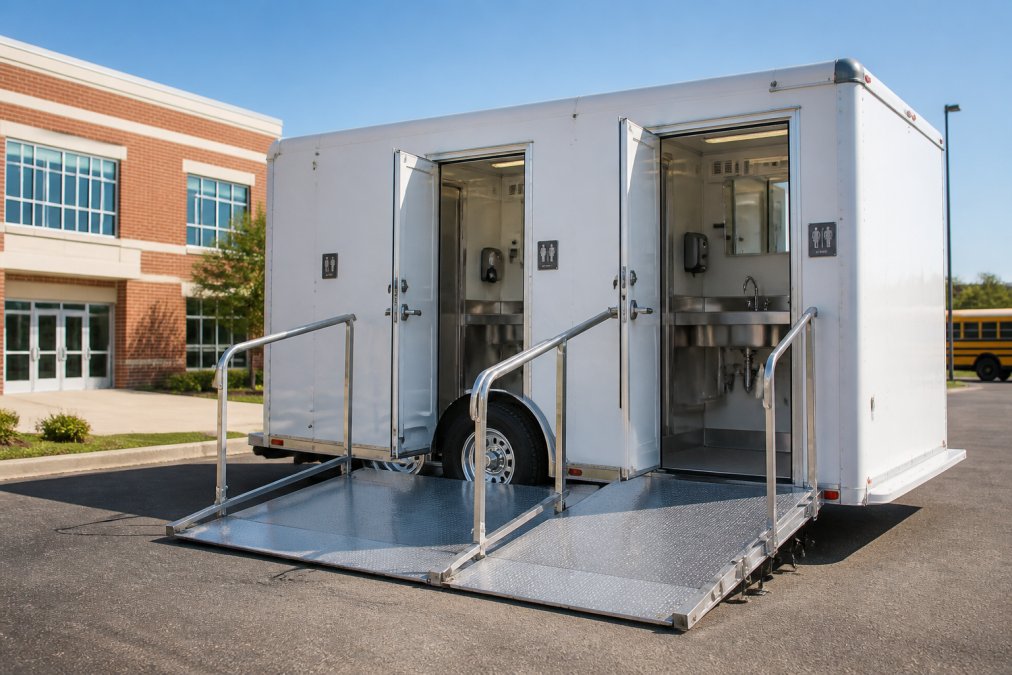
The Royal Thrones ADA-Compliant Restroom Trailer is the top choice for schools because it combines genuine ADA accessibility with climate control, 24-hour service availability, and a professionally maintained fleet that holds up under continuous institutional use.
Schools needing a dependable, ADA-accessible emergency restroom solution with climate control, running water, and round-the-clock support.
The unit features an ADA-approved toilet and sink at compliant heights, grab bars, a full 360-degree wheelchair turning radius, and an easy-access ramp that meets ADA standards. Climate control with both heating and air conditioning means it functions reliably in any season. The self-contained design includes onboard fresh water and waste holding tanks, so it doesn’t require an immediate connection to site utilities, a genuine advantage when infrastructure is compromised. The 24-hour service commitment is critical when a restroom trailer develops a problem during deployment.
Requires: A 110-volt dedicated 20-amp power source or generator. Extended deployments without a direct water source may need supplemental fresh water holding tanks.
ADA Compliant Restroom Trailer Rental: What Schools Must Know
ADA compliant restroom trailer rental is not optional for public schools. The Americans with Disabilities Act requires that temporary facilities provided as substitutes for permanent facilities meet the same accessibility standards as the permanent facilities they replace.
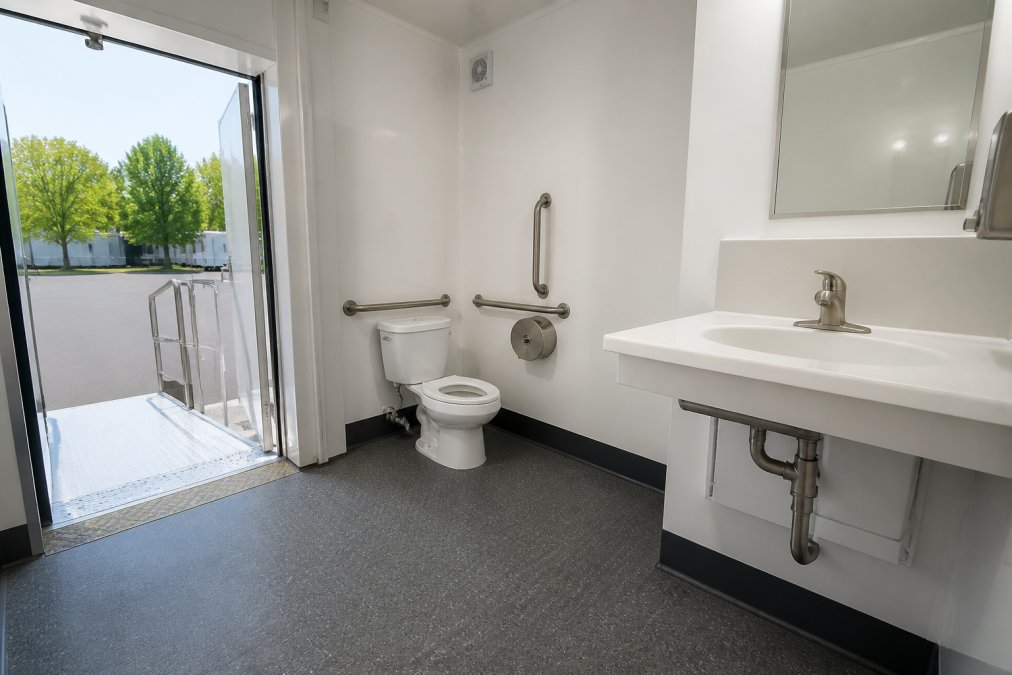
The specific requirements under ADA Standards for Accessible Design include:
- Turning radius: A minimum 60-inch clear floor space for wheelchair maneuverability
- Grab bars: Rear and side grab bars at compliant heights (typically 33-36 inches from the floor)
- Door width: A minimum 32-inch clear opening, with 36 inches preferred
- Ramp access: Slopes not exceeding 1:12 (one inch of rise per 12 inches of run)
- Sink height: Maximum 34 inches to the rim, with knee clearance underneath
Not every trailer marketed as “ADA-accessible” actually meets these specifications. Before signing a rental agreement, request specific measurements and ask the provider to confirm compliance with the current ADA Standards for Accessible Design, which are enforced by the U.S. Department of Justice.
Signing a rental agreement without verifying ADA compliance specifications puts your school district at legal risk. If a student or staff member with a disability cannot use the temporary facility, the district may face an ADA complaint regardless of whether the provider described the unit as compliant.
Key Features to Prioritize for School Sanitation
Climate Control and Interior Amenities
Climate control is the feature that separates a functional temporary restroom from a health hazard. An unheated trailer in February creates a genuine safety risk for students. An un-air-conditioned unit in July creates hygiene problems as waste odors intensify with heat.
The standard specification for school-grade temporary sanitation should include heating and air conditioning with thermostat control, hot and cold running water at sinks, interior lighting sufficient for safe use in low-light conditions, flushing toilets with proper wastewater holding tanks, and handwashing stations with soap dispensers and paper towels or hand dryers.
Rapid Deployment and 24/7 Support
The value of an emergency restroom trailer for schools is measured in hours, not features. A trailer with every amenity that takes 72 hours to deploy is less useful than a simpler unit that arrives in 24 hours.
When evaluating providers, ask directly: what is your guaranteed delivery window for emergency deployments, and what is your 24/7 service response time if a unit develops a problem during deployment? Providers offering genuine 24-hour service availability shift the risk calculus for school administrators.
Integrating Restroom Trailers Into Your School Safety Plan
Most school safety plans address fire, lockdown, and severe weather scenarios in detail. Sanitation infrastructure failure rarely appears. This gap creates the most disruption when something actually goes wrong.
Integrating temporary restroom planning into your school safety plan requires three practical steps:
- Site assessment in advance: Identify two or three viable placement locations on campus that have utility access or can accommodate a self-contained unit with generator and onboard tanks. Document the access routes for a trailer delivery vehicle.
- Pre-qualify a provider: Establish a relationship with a portable sanitation provider before you need one. Confirm their ADA-compliant inventory, deployment timelines, and 24/7 service capabilities. Some districts formalize this as a standing vendor agreement.
- Define activation triggers: Specify in writing what conditions trigger a call to your provider. A confirmed sewage backup? A plumbing failure affecting more than one restroom wing? Clear triggers prevent decision paralysis when the situation is already stressful.
According to Grand View Research’s Portable Toilet Rental Market Report 2024-2030, the global portable toilet rental market is projected to grow from $25.7 billion in 2026 to $34.9 billion by 2030, with emergency response emerging as one of the fastest-growing application segments. Schools that pre-plan for sanitation disruptions are ahead of the curve.
Cost-Benefit Analysis for School Districts
The financial case for a pre-planned emergency restroom trailer program is straightforward: the cost of a rental is a fraction of the cost of sending students home.
A school closure day costs a district in lost instructional time, potential state funding implications tied to attendance, and administrative burden. A multi-station restroom trailer rental for a 2-week renovation or emergency deployment represents a predictable, budgetable expense that keeps the school operational.
The cost variables that matter for school districts:
| Cost Factor | What Drives It |
|---|---|
| Number of stations | Student population and peak usage periods |
| Rental duration | Renovation timeline or recovery period |
| ADA configuration | Number of students/staff requiring accessible facilities |
| Servicing frequency | Waste tank capacity vs. daily usage volume |
| Delivery distance | Site location relative to provider depot |
For districts managing planned renovations, rental costs can be incorporated into the renovation project budget as a facilities continuity expense. For unplanned emergencies, having a pre-negotiated rate with a provider eliminates the premium that comes with urgent, unplanned procurement. A school district that treats temporary sanitation as a line item in its facilities planning budget will spend less and manage the situation more effectively when it arises.
=== FAQ ANSWERS (audit these too, same rules) ===
[1] Q: What are the ADA requirements for emergency restroom trailers in schools?
A: Under the Americans with Disabilities Act, school restroom facilities must provide wheelchair-accessible stalls with at least a 60-inch turning radius, grab bars at specified heights, accessible sinks, and a compliant entry ramp. ADA-compliant restroom trailers designed for schools include all of these features: appropriately sized interiors, grab rails, push-button controls, and ramps that meet federal slope standards. Confirming ADA compliance with your rental provider before delivery protects the school from liability and ensures every student and staff member has equal access.
[2] Q: How quickly can an emergency restroom trailer be deployed to a school site?
A: Most providers can deliver an emergency restroom trailer within 24 to 48 hours of an initial request, depending on availability and distance. Providers with 24/7 support and pre-staged fleets can respond fastest. Schools should conduct a site assessment in advance, confirming access routes, utility hookups, and placement areas so delivery teams can set up without delays.
[3] Q: How many restroom trailers does a school need during an emergency?
A: A standard planning benchmark is one toilet station per 50 people for short-duration situations, and one per 25 to 30 people for extended use or all-day occupancy. A school with 300 students and staff would need a minimum of 6 stations for basic coverage, and closer to 10 to 12 stations for full-day comfort. Station configuration matters too: units should split capacity between women’s stalls and men’s stalls plus urinals. Confirm your enrollment count and the expected duration with your rental provider to size the order correctly.
[4] Q: Are emergency restroom trailers climate-controlled?
A: Premium emergency restroom trailers include both air conditioning and heating, making them suitable for year-round school use. Some units are rated to operate in temperatures as low as -20°F. Climate control is especially important for student health and comfort during multi-day emergencies, renovations, or disaster-response situations. When requesting a quote, confirm that the unit has independent HVAC rather than relying solely on passive ventilation, and ask whether a generator is included or needs to be arranged separately.
[5] Q: What utility hookups do school restroom trailers require?
A: Most restroom trailers need a 110-volt dedicated 20-amp electrical connection and a standard water supply line. Self-contained units carry onboard freshwater tanks ranging from 150 to 300 gallons and separate wastewater holding tanks, eliminating the need for a direct sewer connection. For extended school use, providers typically schedule recurring water refills and waste pump-outs. Schools in areas with limited infrastructure can pair a trailer with a generator and an auxiliary water tank to maintain full operation without permanent utility access.
Frequently Asked Questions
Q: What are the ADA requirements for emergency restroom trailers in schools?
A: Under the Americans with Disabilities Act, school restroom facilities must provide wheelchair-accessible stalls with at least a 60-inch turning radius, grab bars at specified heights, accessible sinks, and a compliant entry ramp. ADA-compliant restroom trailers designed for schools include all of these features: appropriately sized interiors, grab rails, push-button controls, and ramps that meet federal slope standards. Confirming ADA compliance with your rental provider before delivery protects the school from liability and ensures every student and staff member has equal access.
Q: How quickly can an emergency restroom trailer be deployed to a school site?
A: Most providers can deliver an emergency restroom trailer within 24 to 48 hours of an initial request, depending on availability and distance. Providers with 24/7 support and pre-staged fleets can respond fastest. Schools should conduct a site assessment in advance, confirming access routes, utility hookups, and placement areas so delivery teams can set up without delays.
Q: How many restroom trailers does a school need during an emergency?
A: A standard planning benchmark is one toilet station per 50 people for short-duration situations, and one per 25 to 30 people for extended use or all-day occupancy. A school with 300 students and staff would need a minimum of 6 stations for basic coverage, and closer to 10 to 12 stations for full-day comfort. Station configuration matters too: units should split capacity between women’s stalls and men’s stalls plus urinals. Confirm your enrollment count and the expected duration with your rental provider to size the order correctly.
Q: Are emergency restroom trailers climate-controlled?
A: Premium emergency restroom trailers include both air conditioning and heating, making them suitable for year-round school use. Some units are rated to operate in temperatures as low as -20°F. Climate control is especially important for student health and comfort during multi-day emergencies, renovations, or disaster-response situations. When requesting a quote, confirm that the unit has independent HVAC rather than relying solely on passive ventilation, and ask whether a generator is included or needs to be arranged separately.
Q: What utility hookups do school restroom trailers require?
A: Most restroom trailers need a 110-volt dedicated 20-amp electrical connection and a standard water supply line. Self-contained units carry onboard freshwater tanks ranging from 150 to 300 gallons and separate wastewater holding tanks, eliminating the need for a direct sewer connection. For extended school use, providers typically schedule recurring water refills and waste pump-outs. Schools in areas with limited infrastructure can pair a trailer with a generator and an auxiliary water tank to maintain full operation without permanent utility access.
Sanitation disruptions in schools are predictable enough to plan for, and costly enough to take seriously. Royal Thrones offers climate-controlled, ADA-compliant restroom trailer rentals with 24-hour service availability and a professionally maintained fleet built for exactly these situations. Get a Quick Quote from Royal Thrones and have a plan in place before you need one.