
Table of Contents
- The Industry Rule of Thumb for Portable Toilets for Wedding
- Portable Sanitation Calculator for Events: Step-by-Step
- Key Factors Influencing Portable Toilet Quantity
- ADA Compliant Portable Toilet Requirements for Weddings
- Luxury Restroom Trailer vs Porta Potty: What’s Right for Your Wedding
- Placement, Maintenance, and Logistics During Your Event
- Frequently Asked Questions
Last Updated: August 31, 2026
The Industry Rule of Thumb for Portable Toilets for Wedding
The baseline calculation for portable toilets for wedding is straightforward: one stall per 50 guests for a four-hour event with typical food service, soft drinks, and modest alcohol consumption. However, this rule breaks down in real-world scenarios. A 150-guest wedding lasting six hours with full alcohol service needs five stalls, not three. The difference between a five-minute wait and a 20-minute queue comes down to understanding what drives restroom usage, not just dividing headcount by 50.
According to HDR’s 2026 wedding restroom planning guide, this baseline requires adjustments for event duration, alcohol availability, guest demographics, and venue logistics. The good news: calculating your actual need takes 10 minutes and prevents that problem entirely.
The portable toilet rental market is growing because more couples are choosing outdoor and remote venues that lack existing restroom infrastructure. Polaris Market Research’s 2026 portable toilet market report projects the industry will reach $40.6 billion by 2034, with luxury restroom trailers becoming the new expectation for upscale events. This reflects a simple reality: guests at a $50,000 wedding expect restroom facilities that match the venue’s elegance.
Portable Sanitation Calculator for Events: Step-by-Step
Calculating your portable toilets for wedding needs is a five-minute process that accounts for variables that actually matter. Skip generic online calculators, they miss critical details specific to your event. Work through these steps methodically to arrive at a defensible number.
Step 1: Start with Your Guest Count
Begin with your confirmed guest count, not your estimate. Use your final RSVP number. If you’re still in early planning, round up by 10% to account for last-minute additions.
Divide your guest count by 50. This gives your baseline stall count.
Example: 200 guests ÷ 50 = 4 stalls minimum.
This baseline assumes a four-hour event. Adjustments in the following steps will account for longer duration, alcohol service, and other factors.
Step 2: Factor in Event Duration
Event duration directly impacts restroom usage frequency. A four-hour reception generates different peak-usage patterns than a six-hour celebration with cocktail hour, dinner, dancing, and late-night mingling.
For events lasting longer than four hours, add one additional portable toilet for every extra two hours. A six-hour wedding adds one stall to your baseline. An eight-hour event adds two stalls.
Example: Your 200-guest, four-hour baseline was 4 stalls. Extend that to six hours, and you need 5 stalls.
Step 3: Adjust for Alcohol Service
When alcohol is served, add 15-20% more units to your baseline estimate. Alcohol consumption increases restroom usage by approximately 30-40%, with timing concentrated around cocktail hour and later in the evening.
If your baseline was 4 stalls and you’re serving a full bar, add one stall (20% of 4 = 0.8, round to 1). Your new total: 5 stalls.
If you’re serving beer and wine only, add 15% instead of 20%.
Example calculation: 200 guests, 4-hour baseline = 4 stalls. Add 6 hours = 5 stalls. Add full alcohol service = 6 stalls total.
Step 4: Account for Gender Ratio and Guest Demographics
Women statistically require more time per restroom visit than men. If your guest list skews female, increase your total by 10-15%. If your guest ratio is roughly 50/50, no additional adjustment is needed.
Additionally, consider elderly and disabled guests. If you have significant numbers of either group, you’ll need ADA-compliant units and may want to increase your overall stall count slightly to reduce wait times.
Example: Your 6-stall total from the previous steps. If 65% of your guests are women, add 10%: 6 × 1.10 = 6.6 stalls. Round to 7 stalls.
This final number is your portable toilets for wedding target.
Key Factors Influencing Portable Toilet Quantity
Beyond the calculator, several site-specific and logistical variables shape your final decision.
Guest Behavior and Peak Usage Timing
Restroom usage peaks immediately after the ceremony, during cocktail hour, after dinner, and late in the evening. Royal Thrones recommends placing restroom trailers strategically so guests don’t have to walk far during peak times. A 200-person wedding with stalls clustered in one corner creates bottlenecks; distributing them across two locations cuts wait times significantly.
Venue Size and Guest Flow
Compact backyard weddings concentrate guest movement; sprawling farms or vineyards spread guests across larger distances. Smaller venues may need slightly higher stall counts because bottlenecks form more easily. Larger venues can support slightly lower ratios because guests naturally distribute themselves.
Food and Beverage Service Style
Full-service sit-down dinners create predictable usage spikes after the main course. Cocktail-style events with passed appetizers distribute usage more evenly throughout the event.
Climate and Seasonal Considerations
Summer outdoor weddings in hot climates see increased restroom usage due to heat-driven fluid intake. Winter events see lower usage. Extreme heat also stresses portable sanitation equipment. Climate-controlled restroom trailers from Royal Thrones prevent odor and discomfort issues that plague standard porta-potties in summer heat.
ADA Compliant Portable Toilet Requirements for Weddings
Federal accessibility standards require that any public gathering provide accessible restroom facilities. Even private residential weddings benefit from ADA-compliant units because they accommodate elderly guests, guests with mobility challenges, and families with young children.
For every 20 portable restroom units you rent, include at least one ADA-accessible unit. If you’re renting 6 stalls total, one ADA-compliant unit is sufficient. If you’re renting 8 or more, consider two units to prevent bottlenecks.
An ADA-compliant portable toilet must have a minimum interior width of 32 inches for wheelchair access, grab bars at specific heights, a toilet seat height between 17-19 inches, and clear floor space for wheelchair maneuvering. Standard porta-potties don’t meet these requirements.
Royal Thrones offers ADA-compliant restroom trailers that exceed minimum standards, featuring wider interiors, handrails, spacious turning radiuses, and accessible sinks. Placement matters as much as the unit itself. Position your ADA-compliant restroom near the main guest area with a level, well-lit, clearly marked pathway.
The ADA’s technical standards for portable restrooms specifies these requirements in detail.
Luxury Restroom Trailer vs Porta Potty: What’s Right for Your Wedding
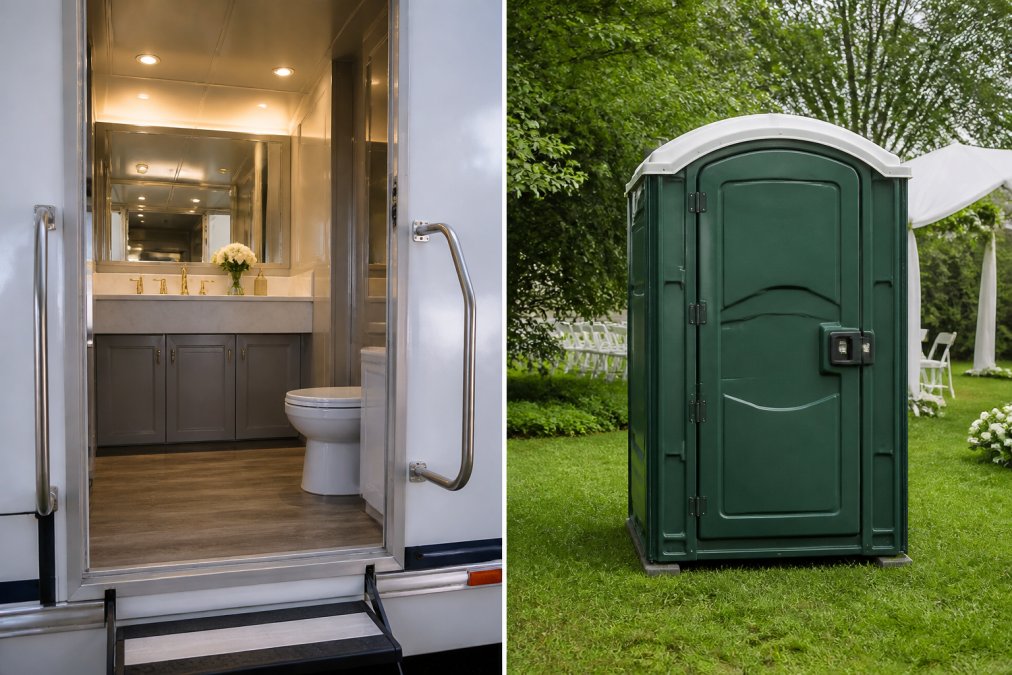
The choice between standard portable toilets and luxury restroom trailers shapes your guests’ entire experience. Standard porta-potties cost less upfront but come with trade-offs: limited privacy, basic ventilation, minimal amenities, and frequent odor issues during warm weather or long events.
Luxury restroom trailers feature climate control, porcelain-flushing toilets, full vanities with running water, mirrors, LED lighting, and sometimes Bluetooth speakers. Interior finishes range from elegant to opulent, with options for decorative rugs, floral arrangements, and hand creams. Guests using a luxury restroom trailer feel pampered.
The cost difference is real, but couples who choose luxury trailers consistently report that guests mention the restroom experience positively, something that never happens with standard porta-potties. For outdoor weddings at high-end venues, luxury restroom trailers align your sanitation facilities with overall event quality. For smaller, casual celebrations, standard units may suffice.
If you’re unsure whether to upgrade to luxury trailers, ask yourself: “Would my guests comment positively on the restroom experience?” If yes, luxury trailers are worth the investment. If they’d simply expect functional facilities, standard units are acceptable.
Placement, Maintenance, and Logistics During Your Event
Where you position your portable toilets for wedding success matters as much as how many you rent. Poor placement creates bottlenecks and guest frustration. Strategic placement ensures smooth traffic flow.
Placement Strategy
Position restroom units within 150 feet of the main guest area, far enough to prevent odors from reaching dining or dancing areas, but close enough that guests don’t face a long walk. At large venues, consider two clusters of restrooms rather than one central location.
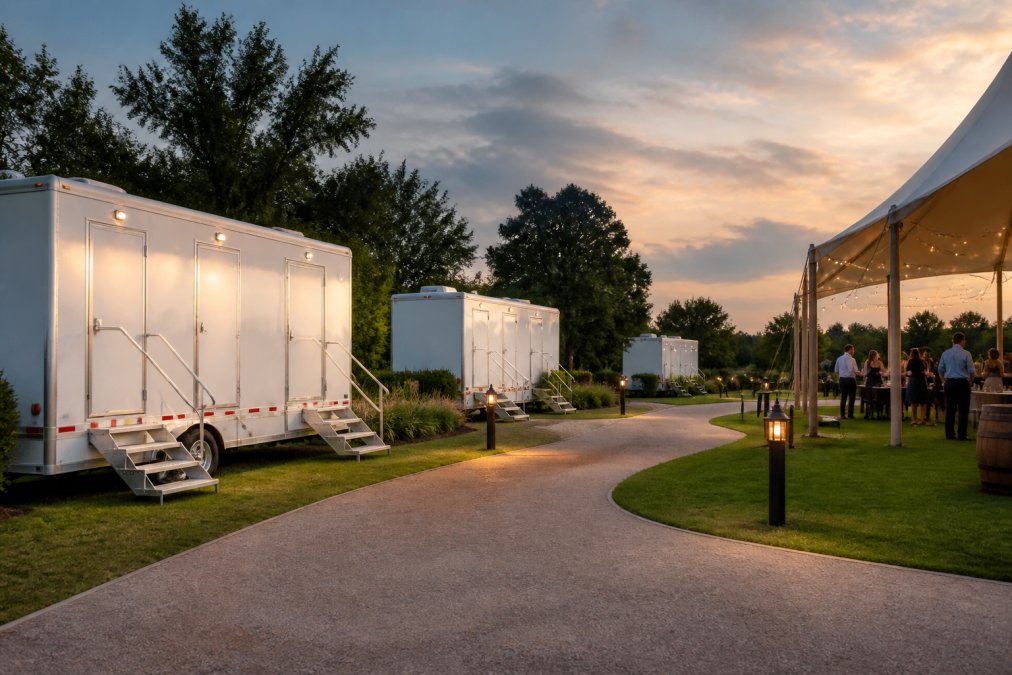
Ensure clear, well-lit pathways to all units. If your event runs into evening, lighting becomes critical. Avoid positioning units upwind of your main guest area if possible.
Maintenance and Supply Restocking
Your rental company should provide regular maintenance throughout your event. For weddings lasting six hours or longer, plan for at least one mid-event restocking and cleaning visit. For events with heavy alcohol service, two visits may be necessary.
Confirm with your rental provider what supplies are included: toilet paper, hand soap, paper towels, and trash removal. Royal Thrones includes comprehensive restocking and cleaning in their service, with 24-hour availability for emergencies.
Attendant Services
For luxury restroom trailers, consider hiring an attendant to monitor cleanliness, restock supplies, and assist guests. An attendant prevents issues from escalating and ensures facilities remain pristine throughout the event.
Neglecting maintenance during your event is a common mistake. A single restroom that isn’t cleaned for three hours creates a domino effect, guests avoid it, all traffic concentrates on remaining units, and complaints multiply. Budget for regular maintenance visits, particularly during peak hours.
Delivery and Pickup Coordination
Confirm delivery timing with your rental company at least two weeks before your event. Units should arrive early enough for setup and inspection, ideally the morning of your event. Pickup should occur the day after, once all guests have departed.
Provide your rental company with clear site access instructions: gate codes, parking locations, and any restrictions on where units can be positioned.
Planning the right number of portable toilets for wedding success requires balancing mathematics with real-world logistics. The industry baseline of one stall per 50 guests works as a starting point, but your final number depends on event duration, alcohol service, guest demographics, and venue layout. Use the step-by-step calculator above to arrive at a defensible number, then adjust based on your specific circumstances.
Royal Thrones helps couples and event planners navigate this decision with restroom trailers that elevate the guest experience. Our climate-controlled units with running water, heating, and air conditioning transform sanitation from a logistical necessity into a hospitality feature. Whether you’re planning a 100-person intimate celebration or a 500-person festival, our diverse fleet, including ADA-compliant options and luxury Opulence trailers, ensures your guests have clean, comfortable, and dependable facilities. Get a quick quote today and discover why event planners trust Royal Thrones for their most important celebrations.
=== FAQ ANSWERS (audit these too, same rules) ===
[1] Q: How many portable toilets do I need for a 150-person wedding lasting 6 hours?
A: For a 150-person wedding lasting 6 hours with typical food service and soft drinks, start with 3 portable toilet stalls (one per 50 guests). If alcohol is served, add 15-20% more units, bringing your total to 4 stalls. An ADA-compliant unit should be included. Consider a luxury restroom trailer instead of standard porta potties to ensure guest comfort and reduce long lines during peak usage periods.
[2] Q: Does serving alcohol at a wedding increase the number of portable toilets needed?
A: Yes, significantly. Alcohol consumption increases restroom usage by approximately 30-40%, so you should add 15-20% more portable sanitation units to your baseline estimate. For example, a wedding that would normally need 3 units should plan for 4-5 units when full alcohol service is available. This adjustment prevents long lines and ensures adequate capacity throughout the event.
[3] Q: What makes a portable toilet ADA-compliant, and how many do I need?
A: ADA-compliant portable toilets feature wheelchair-accessible entry, grab bars, and adequate interior space for wheelchair maneuvering. For events open to the public, add a minimum of one ADA-accessible restroom per 20 portable sanitation units. For private weddings, include at least one ADA-compliant unit if you have elderly guests or attendees with mobility challenges. Luxury restroom trailers often exceed ADA requirements with spacious interiors and modern amenities.
[4] Q: Why should I rent a luxury restroom trailer instead of standard porta potties for my wedding?
A: Luxury restroom trailers offer climate control, running water, flushing porcelain toilets, vanities, LED lighting, and premium finishes that match upscale event aesthetics. Standard porta potties lack these amenities and can create an uncomfortable experience for guests. Elevated guest experience ranks as the top investment priority for modern couples, and luxury trailers deliver comfort, privacy, and hospitality that standard portable toilets cannot match.
Frequently Asked Questions
How many portable toilets do I need for a 150-person wedding lasting 6 hours?
For a 150-person wedding lasting 6 hours with typical food service and soft drinks, start with 3 portable toilet stalls (one per 50 guests). If alcohol is served, add 15-20% more units, bringing your total to 4 stalls. An ADA-compliant unit should be included. Consider a luxury restroom trailer instead of standard porta potties to ensure guest comfort and reduce long lines during peak usage periods.
Does serving alcohol at a wedding increase the number of portable toilets needed?
Yes, significantly. Alcohol consumption increases restroom usage by approximately 30-40%, so you should add 15-20% more portable sanitation units to your baseline estimate. For example, a wedding that would normally need 3 units should plan for 4-5 units when full alcohol service is available. This adjustment prevents long lines and ensures adequate capacity throughout the event.
What makes a portable toilet ADA-compliant, and how many do I need?
ADA-compliant portable toilets feature wheelchair-accessible entry, grab bars, and adequate interior space for wheelchair maneuvering. For events open to the public, add a minimum of one ADA-accessible restroom per 20 portable sanitation units. For private weddings, include at least one ADA-compliant unit if you have elderly guests or attendees with mobility challenges. Luxury restroom trailers often exceed ADA requirements with spacious interiors and modern amenities.
Why should I rent a luxury restroom trailer instead of standard porta potties for my wedding?
Luxury restroom trailers offer climate control, running water, flushing porcelain toilets, vanities, LED lighting, and premium finishes that match upscale event aesthetics. Standard porta potties lack these amenities and can create an uncomfortable experience for guests. Elevated guest experience ranks as the top investment priority for modern couples, and luxury trailers deliver comfort, privacy, and hospitality that standard portable toilets cannot match.