
Last Updated: November 4, 2026
Quick Summary
Portable restroom trailer power requirements depend on the trailer’s climate control system, water pump and lighting load, and how many appliances run at once. Confirm the exact voltage and amperage your restroom trailer power setup needs with the rental team before delivery, since a basic unit may need only a 20-amp circuit while a climate-controlled trailer can require 50 amps.
- Air conditioning and heat are the biggest electrical loads on any restroom trailer.
- A dedicated circuit serves the trailer alone and prevents mid-event breaker trips.
- Size a generator to cover the largest motor’s surge watts plus all running watts, with 20 to 25 percent headroom.
- Keep voltage drop under about 3 percent on a branch circuit by matching cord gauge to length and amperage.
- Most event power failures trace to an overloaded circuit, tripped breaker, loose connection, or undersized generator.
Table of Contents
- What Your Restroom Trailer Power Requirements Actually Depend On
- Standard 110-Volt and 120-Volt Service Explained
- Dedicated Circuits vs. Shared Circuits on Site
- Restroom Trailer Generator Requirements for Remote Sites
- Portable Restroom Trailer Water Hookup and Site Preparation
- Extension Cord Gauge, Voltage Drop, and Electrical Safety
- Troubleshooting Common Power Failures During an Event
- Plan Your Power Setup With Royal Thrones
- Frequently Asked Questions
What Your Restroom Trailer Power Requirements Actually Depend On
Portable restroom trailer power requirements depend on three things: the trailer’s climate control system, its water pump and lighting load, and how many appliances run at once. A basic unit may draw far less than a fully climate-controlled luxury trailer, and that gap decides whether you need a 20-amp household circuit or a 50-amp connection. Confirm these details with the Royal Thrones team before delivery, because the wrong power source can cause a unit to underperform on site.
Here is the short version: match the circuit to the trailer, not the other way around.
Why Climate Control Drives the Electrical Load
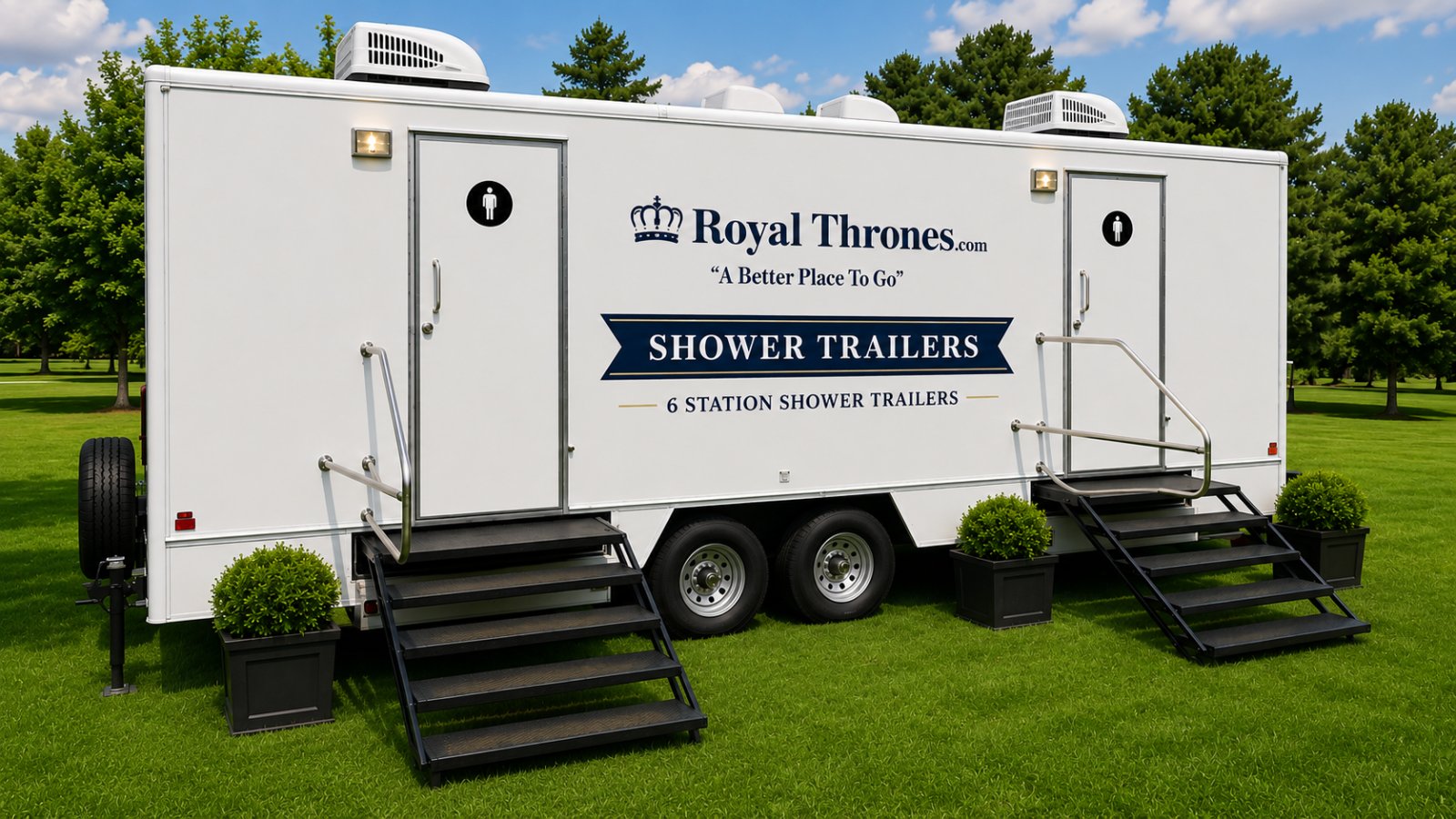
Air conditioning and heat are the biggest electrical loads on any trailer. A climate-controlled unit runs a compressor and blower for hours, and that draw dwarfs what the lights and water pump use. The climate controlled restroom trailer benefits page explains how that comfort translates on site, but the electrical takeaway is simple: if the trailer is heated or cooled, plan your power around the HVAC system first.
Standard 110-Volt and 120-Volt Service Explained
Restroom trailer power requirements vary by model. Confirm the voltage and amperage a specific trailer needs using its spec sheet or the rental team.
The National Electrical Code guidance from NFPA sets the safety baseline electricians follow for these hookups. Confirm the exact voltage and amperage your trailer needs with the rental team before you arrange a circuit.
20-Amp, 30-Amp, and 50-Amp Connections
Think of amperage as the size of the pipe carrying power. Your trailer’s spec sheet states which circuit size it needs, and using a smaller circuit than required will trip breakers.
Dedicated Circuits vs. Shared Circuits on Site
A dedicated circuit serves the trailer and nothing else. A shared circuit splits power with other equipment, which is where trouble starts. When a trailer shares a circuit with catering equipment, lights, or a sound system, the combined load can exceed the breaker’s rating and cut power mid-event.
If you must share, add up the loads first and keep the trailer’s draw well under the circuit’s limit. The safe move is a dedicated line.
Restroom Trailer Generator Requirements for Remote Sites
Remote sites without shore power may need a portable generator sized to the trailer’s electrical load. Shore power is grid electricity from a building or pedestal; a generator replaces it when no grid connection exists. Calculating the total startup wattage of all onboard appliances prevents these frequent power failures, making the process of choosing generator size a critical step in ensuring reliable operation at any location.
Running Watts vs. Surge Watts
Every load on a trailer has two numbers. Running watts is what the equipment draws once it is up and running. Surge watts (sometimes called starting watts) is the brief spike when a compressor or pump motor first kicks on. HVAC compressors and water pumps are motor loads, and their surge can be several times their running draw for a second or two.
A Simple Generator Sizing Method
Use this sequence to size a generator for a restroom trailer:
- Find the trailer’s running watts on its spec sheet, or ask the rental team for the figure.
- Identify the largest motor load, usually the HVAC compressor, and note its surge watts.
- Add the running watts of the water pump, lighting, and any other simultaneous loads.
As a worked example: if a trailer’s HVAC draws 1,500 running watts with a 4,500-watt surge, and the pump and lights add 400 running watts, the peak demand is about 4,900 watts.
Watch out: a generator running near its ceiling for hours is a recipe for a mid-event failure, and fuel consumption climbs as load rises, plan refueling windows that do not interrupt the event.
Inverter vs. Conventional Generators
Conventional generators are the common choice for job sites and events and handle motor surge well. Inverter generators produce cleaner power and run quieter, which matters for weddings and ceremonies near seating, but they are often smaller per unit and may need to be paralleled to carry a climate-controlled trailer. Confirm with the rental team which type suits your trailer and site; noise ordinances and venue rules can also affect the choice.
When a Generator Is the Wrong Answer
If the site has a stable pedestal or building circuit within reach, shore power is simpler, quieter, and avoids fuel handling. Generators make sense for remote fields, construction sites, and venues without an accessible hookup. If you are unsure which applies, describe the site conditions when you request a quote and the team can help you decide.
Portable Restroom Trailer Water Hookup and Site Preparation
The portable restroom trailer water hookup needs a potable water source and a level pad. Trailers with running water need a potable water source and a level, firm surface so the tanks and pumps work correctly.
Level the pad, confirm the water source is clean and pressurized, and map the hose run so it does not become a trip hazard. If you want the full picture of what delivery day looks like, read what to expect when you rent a luxury restroom trailer.
Extension Cord Gauge, Voltage Drop, and Electrical Safety
Extension cord gauge determines how much power actually reaches the trailer. A cord that is too thin for the load causes voltage drop: the trailer receives less voltage than it needs, motors run hot, and performance suffers. The longer the run and the higher the amperage, the more voltage is lost along the way. This is why a cord that works fine at 25 feet can cause problems at 100 feet.
How Voltage Drop Works
Voltage drop is the loss of voltage as current travels through a conductor’s resistance. It rises with distance and with amperage, and it falls as wire gauge gets thicker (lower gauge number). A common rule of thumb among electricians is to keep voltage drop under about 3 percent on a branch circuit so equipment receives close to its rated voltage.
Distance-to-Gauge Reference
The table below is a general planning guide for 120-volt extension cords at common trailer amperages. It reflects typical practice, not a code requirement; always confirm the cord rating with the trailer’s spec sheet and a qualified electrician.
| Cord length | 20-amp load | 30-amp load | 50-amp load |
|---|---|---|---|
| Up to 25 ft | 12 AWG | 10 AWG | 6 AWG |
| 25-50 ft | 10 AWG | 8 AWG | 6 AWG |
| 50-100 ft | 8 AWG | 6 AWG | 4 AWG |
| 100-150 ft | 6 AWG | 4 AWG | 2 AWG |
For runs beyond about 150 feet, voltage drop becomes hard to manage with portable cord, and a different approach, a closer power source, a generator, or a heavier feeder, is usually the better answer.
Cord Ratings and Outdoor Use
Look for cords marked for outdoor use and rated for the amperage of the circuit. A cord’s jacket rating (often printed as SJTW, SOW, or similar) tells you whether it is intended for wet locations and heavy duty.
Watch out: daisy-chaining two lighter cords to reach a distant outlet adds resistance at every connection and can defeat the gauge you thought you had, use one cord of the correct gauge instead.
Ground Fault Protection and Wet Conditions
Outdoor circuits should have ground fault circuit interrupter (GFCI) protection, which shuts off power when current leaks to ground, the scenario that causes shock in wet conditions. Keep all connections elevated off wet ground, use cord covers at walkways, and inspect cords for cuts or worn jackets before the event. The OSHA electrical safety guidance covers outdoor power hazards, and the same principles apply at an event site.
Matching the Cord to the Trailer
Before delivery, confirm three things with the rental team: the trailer’s plug type, the amperage of the circuit you plan to use, and the distance from that circuit to where the trailer will sit. Those three answers determine the cord you need. If the distance is long or the amperage is high, it is often cheaper and safer to move the power source closer than to buy a very heavy cord.
Troubleshooting Common Power Failures During an Event
Most power failures at events trace to four causes: an overloaded circuit, a tripped breaker, a loose connection, or an undersized generator. Check the breaker panel first. If it tripped, reduce the load before resetting it. Then check the cord connections at both ends. If the trailer is on a generator, confirm the generator is still running within its capacity.
A trailer that loses power mid-event loses lighting and climate control fast. Our uptime guarantee for portable restroom trailers explains how we support rentals when something goes wrong. Know your breaker locations and keep a flashlight handy.
Plan Your Power Setup With Royal Thrones
Getting the power right starts with the right trailer. Browse the restroom trailer lineup to match a unit’s power needs to your site, and if you are in the region, the St Louis service page confirms availability and quotes for your area.
Tell Royal Thrones your location, date, guest count, and rental duration. We will help you choose the right trailer and prepare a quote.
Frequently Asked Questions
What are the power requirements for a restroom trailer?
Most climate-controlled restroom trailers run on standard 110-volt or 120-volt service, with larger units often needing higher-amperage connections to carry the air conditioning, heating, lighting, and water pump. The exact restroom trailer power draw depends on the model, the season, and how many fixtures are running. Ask Royal Thrones for the electrical spec sheet for the specific trailer you are considering, then confirm your site has the matching circuit before delivery day.
Do restroom trailers require a dedicated electrical circuit?
Yes, a dedicated circuit is strongly recommended. Sharing a circuit with catering equipment, lighting rigs, or space heaters can trip breakers mid-event and interrupt the HVAC system and water pump. A dedicated circuit sized to the trailer’s amperage keeps the electrical load stable. If your venue cannot provide one, a properly sized portable generator is the usual backup, and Royal Thrones can talk through which option fits your site.
Can I run a restroom trailer on a portable generator?
Yes. Restroom trailer generator requirements depend on the trailer’s total electrical load, including the HVAC system, lighting, and water pump. A generator must be rated above the trailer’s running load with headroom for startup surge, and it needs to sit outdoors with proper ventilation and a safe distance from guests. Tell Royal Thrones your site has no shore power and they can help you confirm the generator size the trailer needs.
What happens if my event site does not have electricity?
You have two practical options: bring in a portable generator sized to the trailer, or choose a trailer setup that does not rely on site power. Generators work well for remote fields, farms, and construction sites, but they need fuel planning and safe placement away from guest areas. Share your site details with Royal Thrones when you request a quote so the team can confirm what the location and the trailer model require.
How do I determine the correct extension cord gauge for my trailer?
Extension cord gauge depends on amperage and distance. A longer run increases voltage drop, so the cord needs to be thicker to deliver stable power to the trailer. Undersized cords overheat and can trip the breaker panel. Keep the run as short as possible, use heavy-duty cords rated for outdoor use, and confirm the gauge with Royal Thrones before the event rather than guessing on site.
Are there different power needs for shower trailers versus restroom trailers?
Shower trailers typically draw more power because of water heating and ventilation on top of lighting and climate control. A luxury restroom trailer with air conditioning already carries a significant electrical load, and adding hot water raises it further. Ask for the amperage requirement of the specific shower trailer model, since assuming it matches a restroom unit can leave you short on power.
Power problems are preventable when you plan the circuit, the cord, and the generator before the event. Royal Thrones supplies climate-controlled trailers with running water, heating, and air conditioning, backed by 24-hour service and well-lit interiors, so your guests stay comfortable from setup to teardown. Get started with Royal Thrones and lock in a power plan that holds up all day.
