
Table of Contents
- What a Portable Restroom Trailer Uptime Guarantee Actually Covers
- Portable Toilet vs Restroom Trailer: Why Uptime Expectations Differ
- How to Read a Portable Restroom Trailer Rental Service Level Agreement
- Restroom Trailer Maintenance Checklist That Protects Your Uptime
- What Happens When a Trailer Breaks Down Mid-Event
- Pricing, Peak Season, and What Reliability Costs
- Frequently Asked Questions
Last Updated: September 10, 2026
What a Portable Restroom Trailer Uptime Guarantee Actually Covers
Portable restroom uptime is a written commitment that a rental unit will remain functional and available for a defined percentage of the rental period, with penalties or remedies when it falls short. According to Dataintelo’s 2026 Portable Restroom Trailer Market Report, the sector was valued at $1.8 billion in 2025 and is projected to reach $3.1 billion by 2034, growth driven largely by buyers who now treat sanitation reliability as a procurement line item rather than an afterthought. At Royal Thrones, we understand the importance of defined uptime terms for event planners and facility managers.
Uptime in this context has three components: mechanical reliability (flushing toilets, pumps, climate control), supply continuity (fresh water and waste holding tank capacity), and response time (how fast a vendor reaches the site when something fails). A guarantee that covers only the first is marketing. One that covers all three is a service level agreement.
Most rental contracts bury uptime language in a maintenance clause. Read for it before you sign, not after the first stall backs up.
A real uptime guarantee states a percentage, a measurement window, and a remedy. “We maintain our units” is not a guarantee. “99% uptime measured across the rental period, with a 24-hour emergency maintenance response” is.
Portable Toilet vs Restroom Trailer: Why Uptime Expectations Differ
Standard portable toilets and restroom trailers fail in fundamentally different ways, so comparing their uptime on one scale misleads buyers. A portable toilet is a single holding tank with no mechanical systems: it degrades slowly and rarely stops working outright. A trailer runs fresh water lines, waste holding tanks, flushing toilets, and climate control, so it has more components that can fail, but it also delivers a service standard a plastic unit cannot match.
That trade-off is exactly why uptime guarantees exist for trailers and almost never for standard units. For a 250-guest outdoor wedding, a trailer that loses climate control in July is a hospitality failure, not an inconvenience. For a construction site, a trailer with a dead pump means workers leave the site to find facilities.
The practical difference for procurement: standard units are bought on unit count and pump-out frequency. Trailers are bought on capacity, amenities, and the vendor’s ability to keep systems running. According to Stallion’s 2026 portable restroom trailer specifications, an 8-stall trailer is rated for up to 800 guests per day, while a 10-stall unit handles up to 1,000. Those ratings assume everything works.
How to Read a Portable Restroom Trailer Rental Service Level Agreement
A restroom trailer rental service level agreement is the contract section that defines what the vendor owes you when equipment fails, how fast they respond, and what you receive if they miss the target. Most buyers skim it. That is a mistake, because the SLA is where uptime guarantees live or die, and it is the one document a procurement manager can use to compare two vendors on something other than price.
Start by forcing the vendor to state uptime as a number with a measurement window. “99% uptime” is a slogan until you know the denominator. Ask three questions: Is uptime measured per calendar day, per event, or across the full rental term? Is a unit counted as down when any fixture fails, or only when the whole trailer is unusable? And who logs the downtime, the vendor, or you? A vendor that measures its own uptime with no customer-visible log is grading its own homework. The strongest SLAs specify a shared log, a timestamp for every service call, and a written downtime report at the end of the rental.
Then separate response time from resolution time. These are different commitments and vendors routinely sell the first while hiding the second.
- Response time is how long until a human acknowledges the issue. A 24-hour response is standard language in the industry. For a one-day wedding, 24 hours is useless.
- Resolution time is how long until the trailer is functional again, repaired on site, or swapped for a backup unit. This is the number that actually protects your event.
- On-site arrival window is a third commitment some vendors omit entirely. A phone response in an hour means nothing if a technician does not reach the site until the next business day.
Ask for all three in hours, and confirm they apply to your event date, including weekends and holidays. Many contracts quietly exclude weekend response, which is exactly when most events happen.
Next, read the remedy clause. A guarantee without a remedy is a promise, not an obligation. Remedies generally fall into three tiers, and you should know which one your contract uses:
- Service credit. A percentage of the daily rate refunded for each hour or day the unit is down. Common structures credit a full day’s rate once downtime crosses a threshold, often four to six hours.
- Backup unit commitment. The vendor delivers a replacement trailer within a stated window. This is the strongest remedy for events where the trailer is the only facility on site.
- Full refund or termination right. Reserved for extended failures, typically downtime exceeding 24 hours on a multi-day rental.
Finally, read the exclusions line by line. Power loss at the site, vandalism, freezing conditions, and customer-caused damage are commonly excluded, and those exclusions can swallow the guarantee. If your event runs on generator power, ask whether a generator failure voids coverage. If you are renting in a cold-weather month, ask what freeze protection the vendor provides and whether a frozen line counts as a covered failure. A vendor that cannot answer these questions in writing before you sign will not answer them at 9 p.m. on your event night.
The most common mistake is signing an SLA that guarantees a response time but not a resolution time. A vendor can “respond” by phone within an hour and still leave your event without working facilities for a full day. Ask for both, in hours, in writing.
A practical benchmark: a strong SLA names a specific uptime percentage, a measurement window, a response window, an on-site arrival window, a resolution window, a credit schedule, and a backup-unit trigger. If any of those seven items is missing, you are looking at a maintenance clause dressed up as a guarantee. guaranteeing rental availability.
Restroom Trailer Maintenance Checklist That Protects Your Uptime
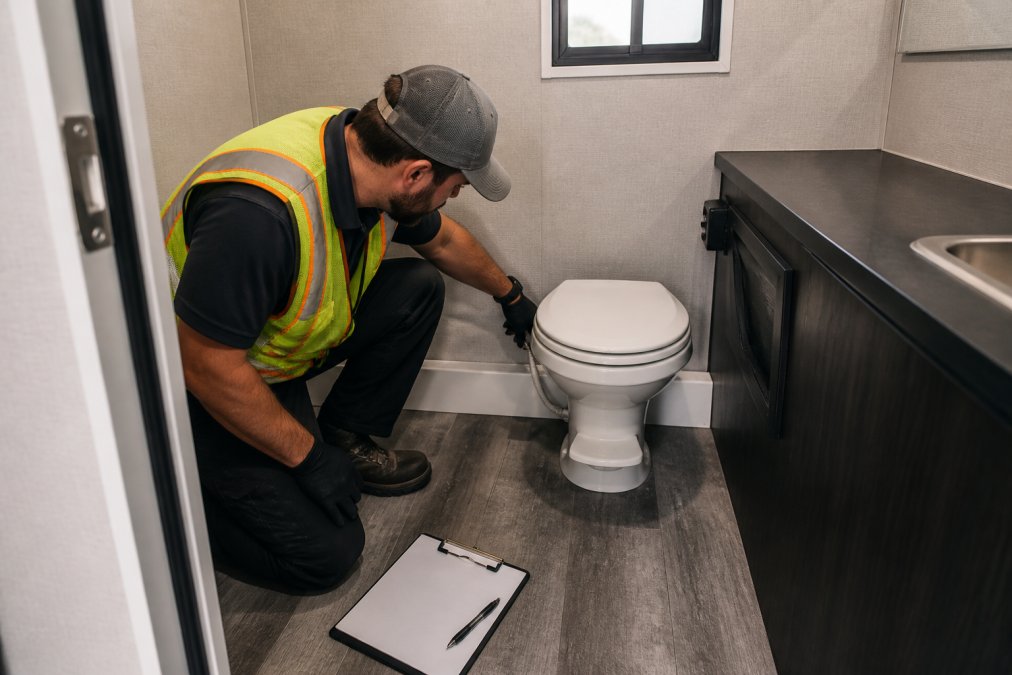
Preventative maintenance is what separates strong portable restroom uptime from a trailer that triggers its guarantee. The checklist below reflects what a real service visit covers, and it is the same sequence a procurement manager can ask a vendor to document before an event.
- Fresh water capacity checked and topped off against expected guest count
- Waste holding tank level verified and pump-out service scheduled
- Every flushing toilet cycled and checked for seal integrity
- Climate control unit tested in both heating and cooling modes
- Water pump and pressure lines inspected for leaks
- Interior lighting confirmed, including emergency and exterior fixtures
- ADA-compliant unit ramp, handrails, and door width verified
- Exterior stabilizers, steps, and tie-downs secured
A common mistake is treating this as a pre-delivery task only. On multi-day rentals, mid-rental service visits are what keep a waste holding tank from becoming the reason your guarantee gets invoked. Royal Thrones offers mid-rental checks for longer bookings.
What Happens When a Trailer Breaks Down Mid-Event
The measure of an uptime guarantee is not whether a trailer fails, but how fast the vendor restores service when it does. Contingency planning is the part competitors skip, and it is where procurement managers get burned. Most rental pages stop at “we respond quickly.” A usable plan goes further: it names who you call, what they do first, how long each step should take, and what you get if the fix fails.
Build the plan around a failure timeline. When a trailer goes down, four things should happen in sequence, and your contract should put a clock on each one.
- Detection and reporting (0-15 minutes). Your on-site contact identifies the failure, a dead pump, a backed-up toilet, a failed climate unit, and calls the vendor’s event-window number. That number must reach a person, not a queue or a general voicemail box. Confirm before the event that the number is staffed during your event hours, including evenings and weekends.
- Triage and remote resolution (15-60 minutes). Many failures are fixable without a site visit: a tripped breaker, a closed water valve, a reset climate unit. A vendor with a real uptime program walks your contact through a short triage script by phone before dispatching a technician. Ask for that script in advance. It saves hours.
- Dispatch and on-site arrival (1-4 hours). If remote triage fails, a technician rolls. The contract should state an on-site arrival window in hours, not “same day.” For a one-day event, a four-hour arrival can still mean the trailer is down for the entire reception.
- Repair or swap (4-8 hours). If the unit cannot be repaired on site, the vendor delivers a backup trailer. This is the step that separates a real guarantee from a phone number. A backup commitment is only meaningful if the contract states the swap window and who pays for delivery.
A workable contingency plan has three elements on paper. First, on-site support contact details that reach a person during the event window. Second, a defined escalation path if the first contact cannot resolve the issue, a named supervisor or dispatcher, with a direct number. Third, a backup unit commitment for events where a single trailer is the only facility on site.
For events with no backup facilities, a wedding on a remote property, a film set, a multi-day festival, ask the vendor in writing what happens if the trailer is unusable for more than two hours. The answer tells you more than the uptime percentage does. A vendor that says “we’ll get someone out” is describing a response. A vendor that says “a replacement trailer arrives within four hours, and you receive a full-day credit for each day the original unit was down” is describing a guarantee.
Case in point: Jots Rentals’ construction sanitation case study documents how prompt maintenance and delivery on large-scale construction projects kept schedules intact because sanitation uptime never lapsed. The lesson generalizes. When a vendor treats maintenance as a scheduled service rather than a reactive call, the failure rate drops before the guarantee is ever tested.
Two questions worth asking every vendor before you sign:
- What is your average time from service call to restored service on a multi-day rental?
- How many backup trailers do you hold in reserve during peak season, and how are they allocated when two customers call the same day?
That second question is the one most buyers never ask, and it is the one that determines whether a backup commitment survives a busy Saturday in July.
A contingency plan is not a phone number. It is a written sequence, detect, triage, dispatch, repair or swap, with a clock on each step and a remedy if the clock runs out. Ask for it before the event, not during it.
Pricing, Peak Season, and What Reliability Costs
Booking lead times matter as much as price. Industry guidance for summer 2026 from luxury restroom trailers are typically reserved 6 to 18 months in advance. Wait until spring and you are choosing from what is left, not from what fits your event.
| Factor | Standard Portable Toilet | Restroom Trailer |
|---|---|---|
| Typical daily cost | Lower | $1200 – $2500 |
| Peak season premium | Minimal | 15-30% (May-Oct) |
| Uptime guarantee | Rarely offered | Standard with SLA |
| Amenities | None | Running water, climate control |
| Best for | High-volume, low-touch sites | Weddings, events, ADA needs |
If a quote comes in well below the market range for your event size, ask what maintenance schedule it includes. The gap is usually a thinner service commitment, not a better deal.
Frequently Asked Questions
What is a standard uptime guarantee for portable restroom trailers?
There is no universal standard. A strong portable restroom uptime guarantee defines uptime as the percentage of rental hours the trailer is fully operational, including flushing toilets, running water, and climate control. It also commits to a 24-hour response window for emergency maintenance and a backup unit if repairs cannot be completed on site. Ask vendors to state their uptime definition in the service level agreement.
How do professional rental companies ensure restroom trailer reliability?
Reliable operators run a documented restroom trailer maintenance checklist before every delivery, including pump-out service, waste holding tank inspection, fresh water capacity checks, and mechanical reliability tests. They also schedule preventative maintenance between rentals and keep spare parts for common failures. This reduces the chance of mid-event breakdowns and protects facility uptime for construction sites and venues.
What happens if a portable restroom trailer breaks down during an event?
Under a solid service level agreement, the vendor dispatches a technician within a set response window, such as 24 hours or faster for peak events. If the problem cannot be fixed on site, the vendor provides a backup trailer or portable sanitation units. Before booking, confirm in writing that the contract includes emergency maintenance, on-site support, and a contingency plan for multi-stall units.
Are ADA-compliant restroom trailers subject to different maintenance standards?
ADA-compliant trailers must maintain accessible features such as ramp width, door clearances, and grab bars, so inspections cover more than plumbing and electrical systems. Maintenance crews check that ramps are stable, handrails are secure, and the interior layout remains unobstructed. These checks help ensure compliance standards are met throughout the rental and that the unit stays usable for guests with mobility needs.
A portable restroom trailer uptime guarantee is only as good as the maintenance program behind it. Royal Thrones backs every rental with climate-controlled units, ADA-compliant options, 24-hour service availability, and a professionally maintained fleet built for weddings, festivals, schools, and job sites alike. Get a Quick Quote from Royal Thrones and lock in a sanitation plan that holds up on the day it matters.