
Last Updated: November 22, 2026
Quick Summary
Successful restroom trailer placement requires level, firm ground, clear space on all sides for steps and queues, and drainage that moves water away from the unit. Never position a trailer at the bottom of a slope, and confirm delivery truck access before finalizing your layout.
- Pavement is the best surface; wet grass turns to mud fast under a trailer and foot traffic.
- Measure the narrowest point of gates and check overhead clearance along the entire delivery route.
- Confirm in writing which circuit the trailer can use and who is responsible for it.
- Place the trailer off to the side of the main event area, screened but reachable in under a minute.
- A trailer needing a mid-event refill must sit where a service vehicle can reach it without crossing guests.
Table of Contents
- Restroom Trailer Site Requirements: Ground, Space, and Drainage
- Restroom Trailer Delivery Access: Truck Routes and Setup Room
- Keeping the Trailer Close but Out of Sight
- Guest Access, Accessibility, and Lighting
- Placement by Venue Type and Event Layout
- Your Restroom Trailer Rental Venue Checklist
- Request a Quote for Your Venue and Date
- Frequently Asked Questions
Restroom Trailer Site Requirements: Ground, Space, and Drainage
Where you place a restroom trailer decides how well the rental works. Get the spot right and guests barely notice the unit.
Placement planning matters before a trailer is delivered, because most setup problems are really site problems in disguise.
Here is the short version: park on level, firm ground, leave clear space on all sides, and never put the unit at the bottom of a slope.
How Much Space a Trailer Actually Occupies
A restroom trailer needs more room than its footprint. Plan for the trailer body, the entry steps, the door swing, and a guest walkway.
- The tow vehicle and its turning path during delivery
- Steps and a landing at each entry door
- A queue area that does not spill into the event
Ask Royal Thrones for the dimensions of the specific model you are considering, and confirm the footprint before you finalize your layout.
Grass, Gravel, Pavement, and Slopes
Ground conditions matter as much as space. Firm, level ground is the goal.
- Pavement: Best option. Stable, drains well, and easy to level.
- Gravel: Workable if packed and level. Loose gravel can shift under weight.
- Grass: Fine when dry and firm. Wet grass turns to mud fast under a trailer and foot traffic.
Watch out: a spot that looks flat in photos often is not. Walk the site in person, or ask us to review it with you before the event.
Restroom Trailer Delivery Access: Truck Routes and Setup Room
Delivery access is the step most hosts forget, and it can stall your whole setup. A restroom trailer arrives on a truck and trailer combination that needs a clear route in, room to turn, and space to back into position. If the truck cannot get there, the placement you drew on paper does not matter.
Walk the route yourself, from the public road to the final spot, and check each of the following.
The Route In
- Gate and opening widths. Measure the narrowest point, not the widest. A gate that fits a pickup may not fit a truck and trailer.
- Overhead clearance. Low branches, string lights, banners, archways, and power or phone lines are easy to miss. Look up along the whole route.
- Surface and load. Gravel, turf, and dirt can shift or sink under a loaded trailer. Note soft spots, recent rain, and existing ruts.
Turning and Backing Room
A trailer is not delivered straight in. The driver needs space to pull past the spot, swing the rig, and back the trailer into position, often more than once.
- A clear area at the end of the route to turn the rig around, or a confirmed plan to back out the way it came in.
- Open space beside and behind the final spot for the backing maneuver.
- No guests, tables, or decor in the delivery zone during setup and pickup.
Watch out: a spot that looks reachable in a photo often is not once a truck and trailer are involved. If you are unsure, ask us to review the route before you finalize the layout.
The Final Position
Once the trailer is in place, the setup still needs room:
- Space for steps and a landing at each entry door.
- Room for the door swing and for guests to enter and exit without crowding.
- A queue area that does not spill into the event, a walkway, or a road.
Coordinating With the Venue and With Us
Delivery works best when three parties agree on the same plan: you, the venue, and the rental provider.
- The delivery window and who will be on site to receive the trailer.
- Any gate codes, lock combinations, or security check-ins.
- Whether the venue requires a certificate of insurance or advance notice for vendor vehicles.
Tell Royal Thrones the site conditions when you book, including any narrow gates, slopes, or overhead obstructions on the route. For commercial projects, see our business remodel restrooms page.
(/portable-restroom-trailer-power-requirements/).
Power: What to Confirm Before You Commit to a Spot
Most restroom trailers need a reliable electrical connection to run lighting, ventilation, water heating, and pumps. The placement question is not just “is there an outlet” but “is there an outlet that can carry the load and stay on.”
- Distance to the nearest power source. A long run means cable across a walkway, a tripping hazard, or a generator instead. Measure it.
- What the circuit serves. A circuit already feeding catering equipment, lighting, or a band is not a safe assumption. Ask the venue which circuits are dedicated.
- Who owns the connection. At a private venue the host may need to arrange it; at a park or fairground the facility manager usually controls access.
Watch out: a venue that “has power” on the day of the site visit may have that power committed to something else on event day.
Water: Supply, Pressure, and the Refill Question
Water supply requirements depend on the trailer model and the event, so confirm with the Royal Thrones team which setup applies to your unit.
- Does this model require a hose connection, or does it carry its own supply?
- If it connects, where is the spigot, and is the pressure and flow adequate for the unit?
- If it carries its own tank, how many guests can it serve before a refill, and who arranges the refill?
A trailer that needs a refill mid-event should not be placed where a service vehicle cannot reach it without crossing the guest area. That is a placement decision you make now, not at hour six.
Waste: Holding Tanks, Drainage, and Servicing
Waste handling is the part guests never see and hosts most often overlook. Waste handling and servicing arrangements depend on the unit and should be confirmed with the Royal Thrones team.
- Servicing access, can a service vehicle reach the trailer without driving through the ceremony or the reception tent?
- Drainage and runoff, the trailer should sit where spilled water and wash-down drain away from the unit, not pool under it.
- Distance from food and gathering areas for servicing and for odor control.
When Utilities Are Unavailable or Fail
Outdoor venues, farms, parks, and construction sites frequently have no usable power or water at the placement spot. That does not rule out the location; it changes the plan.
- A generator placed away from guest seating, if the site has no usable power.
- A water plan confirmed with the Royal Thrones team.
- A named person on site who can reach the venue contact if a connection fails.
Tell the Royal Thrones team at booking if the site has no power, no water, or uncertain access to either, so backup plans can be arranged before the event. If accessibility is also part of your planning, our ADA-accessible restroom trailers page covers how accessible units are laid out and what to confirm about the route to them.
Keeping the Trailer Close but Out of Sight
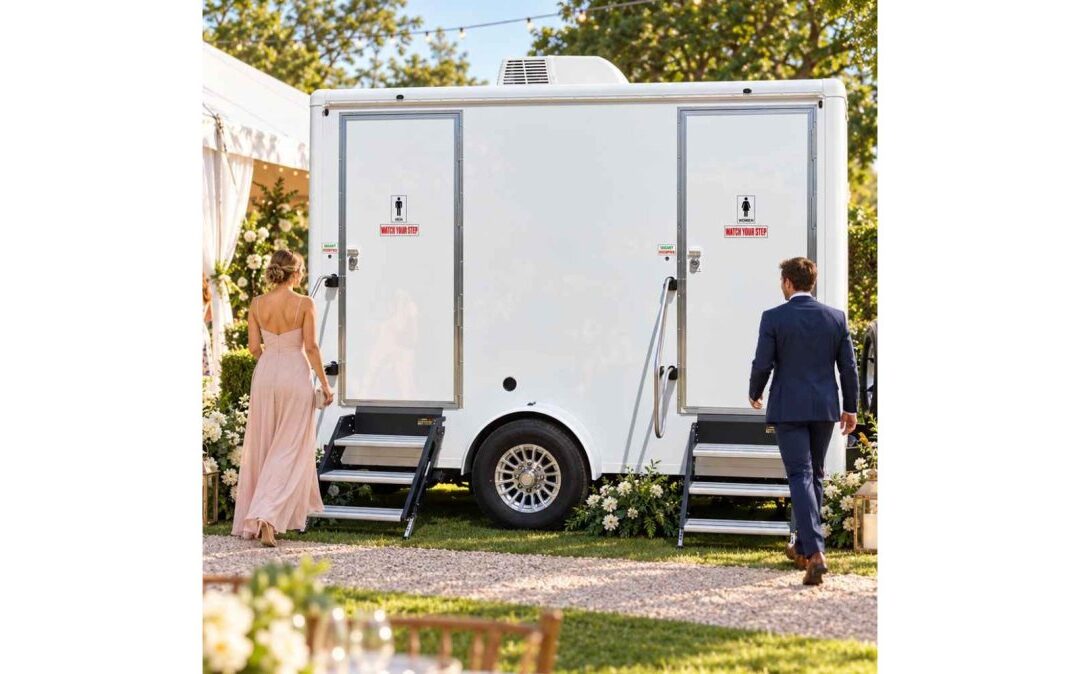
The best restroom trailer placement balances two goals: guests should reach it easily, but it should not sit in the middle of your ceremony photos. Close enough to walk to in under a minute, tucked away enough to stay out of the main sight lines.
A good rule: place the trailer off to the side of the main event area, with a clear path, but behind a natural screen. Guests should be able to find it without asking, and it should not dominate the view.
Screening Options That Fit the Venue
You do not need a construction fence. Simple, attractive screening works.
- Hedges and landscaping: Natural and blends with an outdoor venue.
- Fencing: Wood panels or decorative fencing look intentional.
- Tents and structures: A small canopy or partition hides the unit.
Add signage and a few cones or rope lines to guide guests along the path. Clear direction keeps foot traffic flowing and protects your lawn.
Guest Access, Accessibility, and Lighting
A restroom trailer is only as good as the path to it. Guests should reach the unit on a firm, well-lit route with no steps, roots, or muddy patches in the way.
- A level walkway from the event to the trailer
- Lighting for evening events, on the path and at the entry
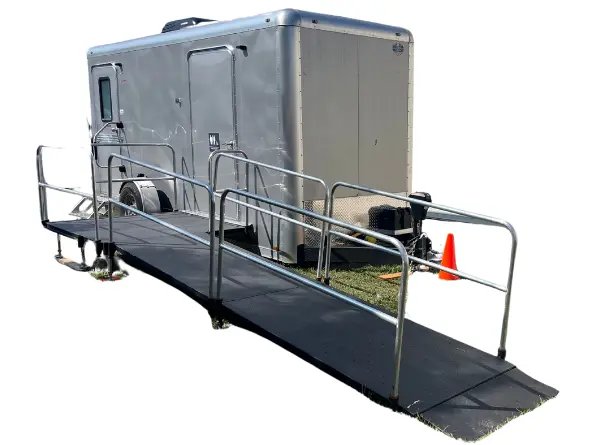
- Accessible routes for guests using wheelchairs or walkers
If accessibility matters for your event, ask about Royal Thrones ADA-accessible restroom trailers and confirm the layout works for your guests. Renting an accessible unit does not by itself satisfy every code or permitting requirement, so check project-specific rules with the appropriate authority and talk with our team about your needs.
Placement by Venue Type and Event Layout
Different venues call for different placement choices. The right spot at a barn wedding is not the right spot at a construction site.
| Venue type | Best placement | Watch for |
|---|---|---|
| Wedding venue | Off to the side, screened, near reception | Sight lines from ceremony photos |
| Festival grounds | Central cluster, clearly signed | Long queues at peak times |
| Construction site | Near worker staging area | Soft ground and truck access |
| School or church event | Close to the gathering, well lit | Accessible routes for all ages |
| Business remodel | Away from customer entrances | Utility access and servicing |
For a wedding, match the trailer to your layout with guidance on the best restroom trailer for weddings. For commercial projects, our business remodel restrooms page covers temporary facilities during renovations.
Your Restroom Trailer Rental Venue Checklist
Use this checklist before you finalize placement. Walk the site and confirm each point.
- Flat, firm ground with no slope
- Enough space for the trailer, steps, and queue
- Clear delivery route with room to turn
If you want to know what the rental and setup process looks like from start to finish, read what to expect when you rent a luxury restroom trailer. It answers the questions most hosts have before the truck arrives.
Request a Quote for Your Venue and Date
Placement is the part you can control, and getting it right makes everything else easier.
Tell Royal Thrones your location, date, guest count, and rental duration. For a full walkthrough of planning your rental, see our guide to renting restroom trailers.
Planning an event or project and not sure where the trailer should go? Send us your site details and dates.
Frequently Asked Questions
Where should a restroom trailer be placed at an event venue?
Start with level, stable ground that can hold the trailer and the delivery vehicle, then work backward to guest flow. The ideal spot sits within a short walk of the reception or event area, has a clear path guests can follow without crossing a dance floor or ceremony aisle, and offers enough open space for the truck to pull in and set up. Keep it far enough from dining and speaking areas that conversations are not disrupted, and screen it with fencing, hedges, or a tent wall if sight lines matter. Confirm the exact spot with your rental company before the event.
How close should a restroom trailer be to the event area?
Close enough that guests can reach it in a minute or two on foot, but not so close that doors, queues, or generator noise intrude on the reception. A short, well-lit walk is usually the right balance. Consider your guest list: older guests, anyone in formal shoes, and guests using wheelchairs or mobility aids will feel every extra step. If the site is large or spread across buildings, ask whether a second unit or a closer placement makes sense. Your rental company can help you weigh distance against screening and access.
Does a restroom trailer need water and electricity?
Most restroom trailers need a power source for lighting, climate control, and water pumps, and many need a water connection or onboard tank. The exact setup depends on the trailer model and what your venue provides. Ask your rental company what the unit requires, whether it can run on a generator, and how far the trailer can sit from the nearest power or water source. Confirm these details before you finalize placement, because moving a trailer after setup is not simple. Venues with limited utilities may need a different unit or a backup plan.
Can a restroom trailer be placed on grass or gravel?
Grass and gravel can work if the ground is firm, level, and dry enough to support the trailer and the delivery vehicle. Soft ground after rain, slopes, and loose gravel can cause settling, tire ruts, or setup problems. Walk the spot in person, check for underground irrigation or utilities, and tell your rental company what surface you have. They can advise whether the trailer needs pads, a different position, or a paved area instead. Never assume a grassy spot will hold without confirming it with the company delivering the unit.
