Table of Contents
- Why Choose Luxury Restroom Trailers Over Standard Porta-Potties?
- Key Differences at a Glance: Trailer vs. Porta-Potty
- The Comfort Factor: Climate Control and Running Water
- Hygiene and Maintenance: What Keeps Units Fresh
- How Many Portable Toilets for 100 Guests? Sizing Your Rental
- Luxury Restroom Trailer Rental for Weddings and VIP Events
- Planning for Accessibility: ADA Compliant Restroom Trailer Rental
- Site Requirements and Logistics for Trailer Delivery
- Frequently Asked Questions
Last Updated: September 9, 2026
Luxury restroom trailers hold a 38.4% product type market share in the portable sanitation industry, according to the Dataintelo Portable Restroom Trailer Market Research Report. That number makes sense when you consider what event planners actually deal with: standard porta-potties create long lines, unpleasant odors, and a noticeable dip in guest satisfaction. The benefits of luxury restroom trailers over porta-potties come down to comfort, hygiene, and logistics, and this guide from Royal Thrones breaks down exactly where the upgrade matters most.
We’ll cover the key differences, climate control and running water benefits, sizing, ADA compliance, and delivery site requirements.
Luxury restroom trailers are climate-controlled, flushable restrooms with running water and lighting. They outperform standard porta-potties on guest comfort, hygiene, and event perception, which is why North America accounts for 44.7% of global market revenue (Dataintelo market analysis).
Why Choose Luxury Restroom Trailers Over Standard Porta-Potties?
The core reason to choose luxury restroom trailers over porta-potties is guest experience. A standard porta-potty is a functional necessity; a restroom trailer is an amenity that reflects your event’s tone.
Industry analysis from IBISWorld’s Portable Toilet Rental analysis shows that luxury units have shifted from a niche offering to a mainstream expectation. Post-pandemic hygiene standards drove demand for climate-controlled, flushing, and premium-finish restrooms. Guests now expect sanitation that feels safe and clean, not just available.
The financial picture supports this shift. Rental operators command higher rates for luxury trailers than for standard porta-potties, which increases profit potential for the rental company and perceived value for the host ServiceCore industry insights. For weddings and VIP events, the restroom is part of the venue experience.
Key Differences at a Glance: Trailer vs. Porta-Potty
The differences go beyond aesthetics. Trailers require more planning but deliver a fundamentally different experience:
| Feature | Standard Porta-Potty | Luxury Restroom Trailer |
|---|---|---|
| Flushing toilet | Rarely | Always |
| Running water sink | No | Yes |
| Climate control | None | Heating and AC |
| Lighting | Minimal | Well-lit interior |
| Capacity per unit | 1 person | Multiple stalls |
| Power hookup needed | No | Yes |
| Typical use case | Construction, basic events | Weddings, VIP, upscale functions |
The logistics are heavier for trailers. They need power and water hookups, and they occupy a larger footprint. Royal Restrooms notes that trailers cost more to rent because they require larger equipment and more complex systems Royal Restrooms cost comparison. That complexity is the trade-off for a restroom that functions like one in a home.
The Comfort Factor: Climate Control and Running Water
Comfort is the clearest advantage: a climate-controlled unit with running water transforms the restroom from a dreaded stop into a pleasant space.
At a July wedding with 250 guests and 95-degree heat, a standard porta-potty becomes unbearable within hours, while a restroom trailer with air conditioning stays comfortable all day and offers a running water sink for proper handwashing.
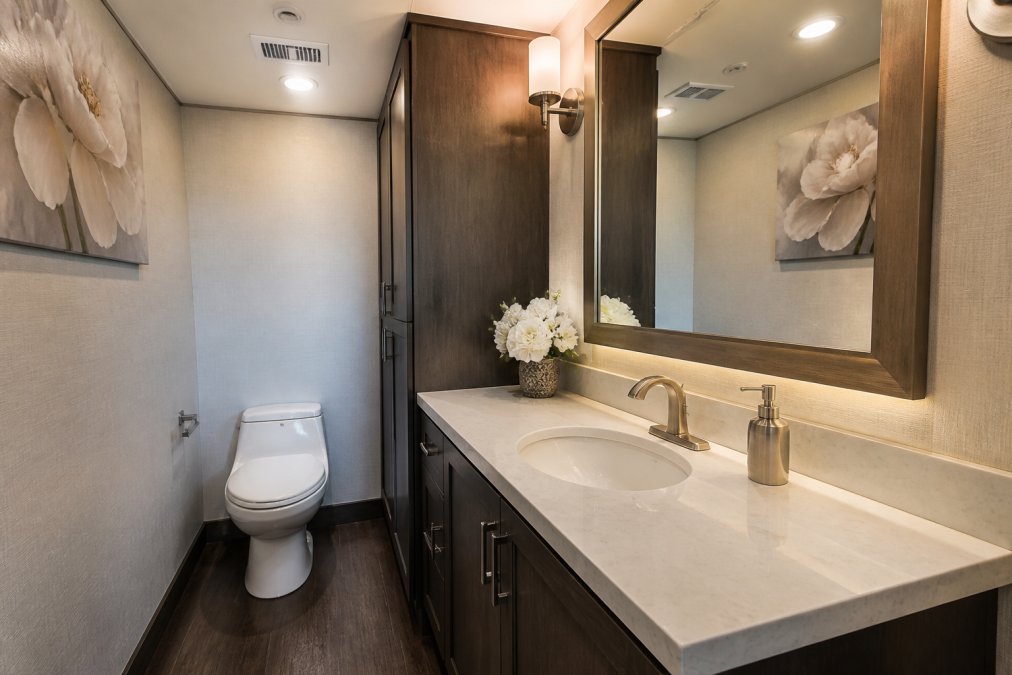
Vanity mirrors, proper lighting, and multiple stalls create a private, well-lit environment, making a measurable difference for elderly guests and families with young children.
When ordering, confirm the unit has both heating and air conditioning. Some hybrid units only offer one. For shoulder-season events in spring or fall, you need both to handle temperature swings from morning to afternoon.
Hygiene and Maintenance: What Keeps Units Fresh
Hygiene is where luxury restroom trailers separate themselves from porta-potties: flushable toilets, running water, and a closed waste system keep units fresh throughout a full day of use.
Here is the actual maintenance protocol that keeps a trailer operating at peak hygiene.
The Waste Management Cycle
A standard porta-potty relies on a holding tank with chemical treatments that mask odors. A luxury restroom trailer uses a similar concept, but the key difference is volume: a typical trailer tank holds 250 to 500 gallons versus a porta-potty’s 60 to 70 gallons.
That capacity difference changes the servicing math: for a 200-guest event, a single porta-potty needs pumping at least once mid-event, while a multi-stall trailer can often run the full event without one. The risk is not overflow, it’s the tank filling to a level where flushing becomes sluggish or the system backs up.
For events exceeding six hours or 150 guests, a mid-event pump can help maintain consistent flush pressure and prevent odor feedback through the plumbing vents.
What Servicing Actually Involves
A full service visit for a luxury trailer includes four distinct steps:
- Wastewater pump-out, A vacuum truck connects to the trailer’s waste outlet and empties the holding tank completely.
- Fresh water refill, The clean water tank is topped off to ensure flushing and sink pressure remain consistent.
- Supply restocking, Toilet paper, hand soap, paper towels, and any amenity items (hand lotion, mints) are replenished.
- Interior sanitation, All surfaces are wiped down with disinfectant, mirrors are cleaned, and floors are mopped or spot-cleaned.
The entire process takes 15 to 20 minutes per trailer, coordinated during a lull, typically dinner service, so guests never encounter a service crew.
Chemical Use and Environmental Considerations
Standard porta-potties often use formaldehyde-based deodorizers and biocides, which can be a concern for venues with strict environmental policies, particularly those near waterways or with on-site septic systems.
Luxury restroom trailers using vacuum-flush or pressure-flush systems often require less chemical treatment because waste is contained in a sealed tank. If your venue has environmental restrictions, ask about the chemical profile of tank treatments, a question that can be a deciding factor for venue approval.
The Supply Depletion Problem
Supply depletion mid-reception is a planning problem, not a trailer problem. A trailer servicing 200 guests for eight hours goes through roughly 3 to 4 rolls of toilet paper per stall and 1 to 2 dispensers of hand soap, so if your agreement lacks a mid-event restock, you rely on the initial supply lasting the full duration.
Ask your provider about their restocking schedule and what happens if supplies run low. A reputable company will have a plan for high-volume events, including a scheduled service visit or an on-call attendant.
The biggest mistake planners make is underestimating usage. A trailer servicing 200 guests for eight hours needs a servicing schedule, not just a full tank at drop-off. Confirm the servicing plan before you sign, and ask whether the provider uses formaldehyde-free tank treatments if the venue has environmental restrictions.
How Many Portable Toilets for 100 Guests? Sizing Your Rental
For 100 guests, a single luxury restroom trailer with two to three stalls is usually sufficient for a standard four-to-six-hour event.
Here is the general guideline for event sizing:
- 1 to 50 guests: 1 trailer or 2 standard units
- 50 to 150 guests: 1 trailer with multiple stalls
- 150 to 300 guests: 2 trailers or 1 trailer plus additional units
- 300+ guests: Multiple trailers based on event duration
The math changes with alcohol consumption, event length, and guest demographics: weddings with an open bar see 30-40% higher usage than dry events. Add one stall per 50 guests if you expect heavy drinking or a long reception.
The advantage of a trailer is throughput. Multiple stalls mean shorter lines, and guests spend less time waiting. For the general event planning guidance on restroom ratios, a single-occupancy porta-potty handles roughly 30-40 guests per event, while a multi-stall trailer handles significantly more.
Luxury Restroom Trailer Rental for Weddings and VIP Events
Weddings are the most common use case for luxury restroom trailer rentals. The restroom is one of the few places guests form an independent opinion of your event’s quality.
A luxury restroom trailer rental for weddings eliminates the “porta-potty stigma,” keeps guests on-site longer, and photographs well where the restroom area is visible.
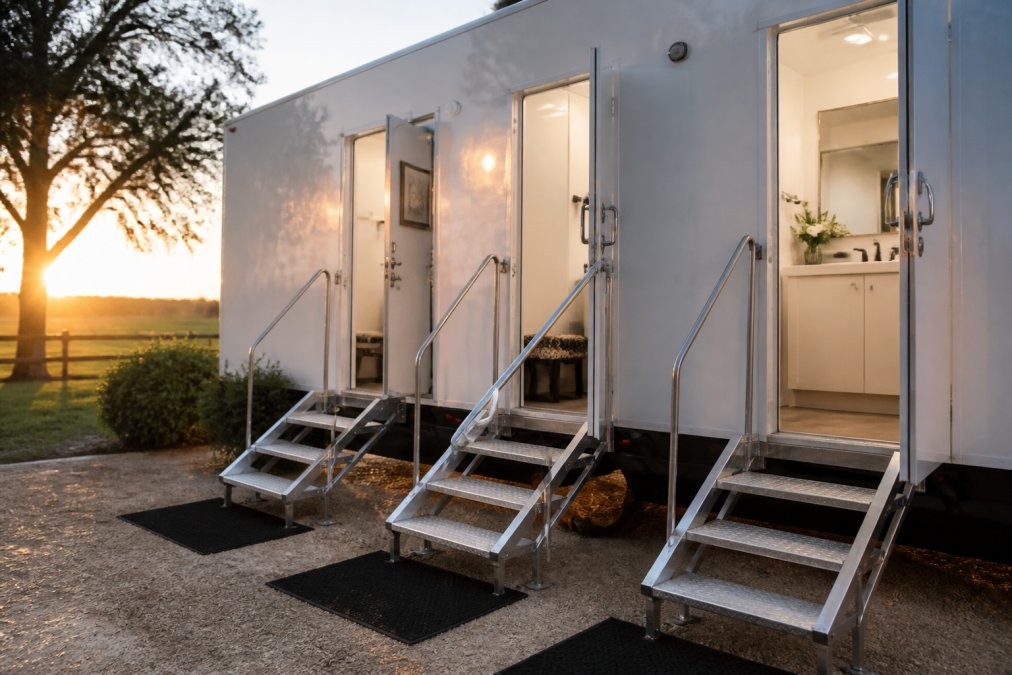
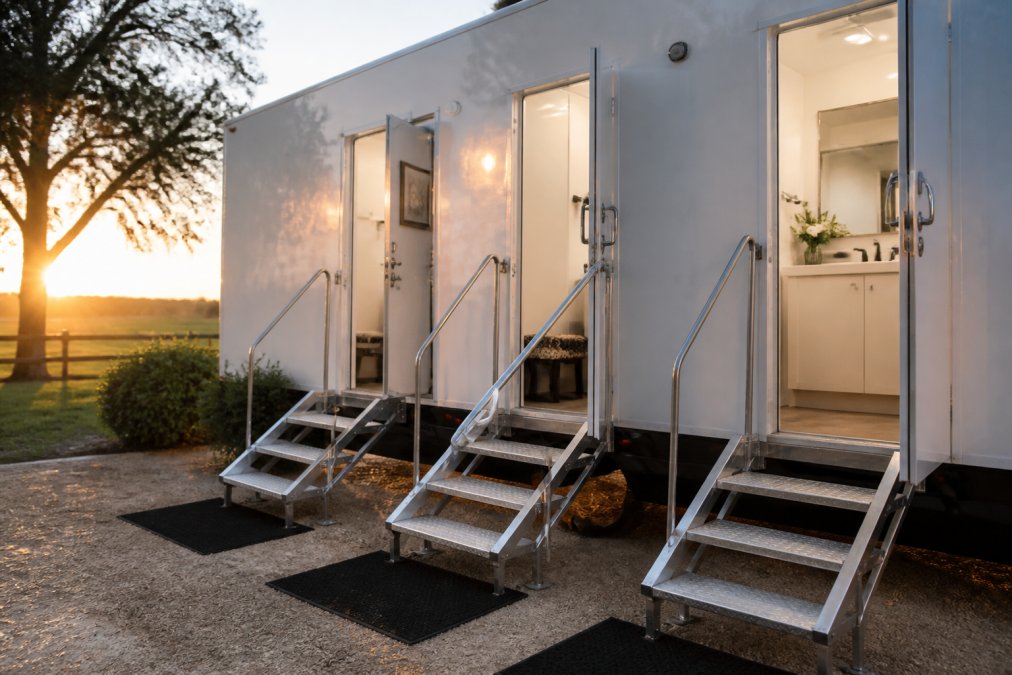
The Opulence line of trailers, with premium finishes and climate control, is designed for upscale functions, featuring multiple stalls, running water, and interior lighting that matches the event’s aesthetic.
For VIP events, the restroom becomes part of the hospitality package. Guests remember whether they felt cared for, and a clean, comfortable restroom is a tangible expression of that care.
Planning for Accessibility: ADA Compliant Restroom Trailer Rental
An ADA compliant restroom trailer rental is not optional for public events. The Americans with Disabilities Act requires accessible restroom facilities at events open to the public.
ADA-compliant trailers feature wider doorways, interior turning space for wheelchairs, grab bars, and sinks at accessible heights, designed so a person using a wheelchair can enter, close the door, and use the facilities independently.
When you book an ADA unit, ask for specific dimensions and layout, as a trailer that meets ADA standards on paper may still be difficult to use if the site approach is uneven or the path is blocked. Confirm the path from the main event area is firm, stable, and slip-resistant.
ADA compliance is about the full path of travel, not just the trailer interior. Check the route from your event space to the unit, including ramps and surface conditions, before the event date.
Site Requirements and Logistics for Trailer Delivery
Delivery logistics for restroom trailers are more involved than for porta-potties, and the single biggest gap in most rental guides is the lack of technical detail on power and water requirements. Here is the practical breakdown you need before you call a rental company.
Power Requirements: Generators and Hookups
A luxury restroom trailer requires a continuous power source for climate control, interior lighting, and the water pump. A typical multi-stall trailer with air conditioning and heating draws between 30 and 50 amps at 120/240 volts.
Your site has three options for power:
- Direct hookup, The trailer plugs into a dedicated electrical pedestal on-site. This is the most reliable option and requires a NEMA 14-50 outlet (the same type used for electric vehicle charging stations or large RVs). If your venue has this outlet within 50 feet of the trailer placement, you are set.
- Generator, If no pedestal is available, the rental company provides a generator. A 50-amp generator is the minimum for a trailer with full climate control. Smaller generators will struggle with the startup surge of an air conditioner compressor.
- Battery with solar, Some newer trailers offer battery backup systems that can run lighting and basic functions for several hours, but full climate control requires a generator or hookup. Do not rely on battery alone for a summer or winter event.
Ask your rental provider for the exact amperage and outlet type, then confirm with your venue that the power source is within the extension cable range. Most trailers come with a 25-foot power cord, but longer runs require heavier gauge cable the rental company should supply.
Water Supply and Wastewater
Running water is the defining feature of a luxury trailer, requiring a water source. The trailer has a fresh water tank filled at delivery, typically holding 100 to 200 gallons, which supplies the sinks and toilets.
For a standard event, the fresh water tank is sufficient for the full duration. For events longer than eight hours or with heavy usage, schedule a mid-event refill, or connect the trailer directly to a venue water spigot with a standard garden hose connection, providing unlimited water but requiring the spigot to be within 50 to 75 feet.
Wastewater is held in a separate tank and must be pumped out by a service truck; the trailer does not connect to a sewer line, a critical distinction, as some venues assume it can tie into their plumbing. The wastewater tank is sized to match the fresh water tank, so servicing schedules are typically aligned.
Site Surface and Access
A fully loaded multi-stall trailer can weigh 8,000 to 12,000 pounds, so the delivery truck needs a stable, level surface that can support this weight. Asphalt, concrete, and compacted gravel are ideal; soft grass, sand, or muddy ground can cause the trailer to settle unevenly, affecting plumbing and making doors stick.
A typical delivery sequence looks like this:
- Site survey to confirm access, surface, and footprint
- Delivery and placement on a level surface using a truck with a lift gate or ramp
- Connection to power (pedestal or generator) and water supply (tank fill or spigot)
- Wastewater tank setup and verification of the outlet location for the service truck
- Interior stocking, climate control test, and final inspection
Allow at least 24 hours lead time for delivery and setup; remote sites may need more. If the delivery truck cannot reach the placement area due to narrow gates, low-hanging branches, or steep grades, the rental company will need an alternate plan, often a smaller trailer or different placement location.
The Operational Side: Uptime and Response
Ask about uptime guarantees and response times for service calls. A company that can send someone out quickly if a unit malfunctions offers significant value, for a high-profile event, this reliability is the real value of a professional rental service.
Before you book, ask the rental company for the trailer’s power requirements (amps and outlet type) and the delivery truck’s access dimensions. Then walk the site with a tape measure. Most delivery failures are not about the trailer, they are about access and power that were never confirmed.
Frequently Asked Questions
How much does it cost to rent a luxury restroom trailer?
Rental costs for luxury restroom trailers vary significantly based on the unit size, features, event duration, and delivery location. Pricing depends on quantity, dates, and delivery. For a precise quote tailored to your event size and specific needs, check the pricing page on the rental company’s website or request a direct quote.
How many portable toilets do I need for 100 guests?
A common industry guideline suggests providing at least one restroom stall per 50-75 guests for a standard event. For 100 guests, this generally means you need at least 2 to 3 portable toilet stalls. However, luxury restroom trailers often feature multiple private stalls, which can reduce the total number of units needed while providing a better guest experience.
Are luxury restroom trailers ADA compliant?
Yes, many rental companies offer ADA compliant restroom trailer rental options. These units are designed to meet the Americans with Disabilities Act (ADA) standards, featuring wider doorways, ample interior space for maneuverability, grab bars, and appropriate sink heights. Always confirm the specific unit’s ADA compliance and ask for layout specifications to ensure it meets your guests’ needs.
What are the main benefits of a restroom trailer over a porta-potty?
The primary benefits of luxury restroom trailers over porta-potties center on guest comfort, hygiene, and aesthetics. Trailers offer flushable toilets, running water for handwashing, climate control for year-round comfort, and interior lighting. They provide a significantly more pleasant and sanitary experience, which is especially valuable for upscale events like weddings or corporate functions.