Table of Contents
- Portable Toilet vs Restroom Trailer Rental: Side-by-Side Comparison
- Amenities, Space, and Site Requirements
- Luxury Restroom Trailer Rental Cost vs Portable Toilet Pricing
- How Many Portable Toilets Do I Need for an Event?
- ADA Compliant Portable Restroom Requirements
- Which Option Fits Your Situation: A Decision Framework
- Maintenance, Servicing, and Environmental Considerations
- Frequently Asked Questions
Last Updated: August 26, 2026
Portable Toilet vs Restroom Trailer Rental: Side-by-Side Comparison
The portable toilet vs restroom trailer rental decision comes down to more than budget. According to USA Portable Toilet Rental Market Outlook to 2030, the U.S. portable toilet rental market is valued at $2.8 billion in 2024 and is expected to grow at 7% annually through 2030, driven by rising demand across construction, events, and emergency response. That growth reflects a market splitting in two directions: basic sanitation for worksites and elevated experiences for events.
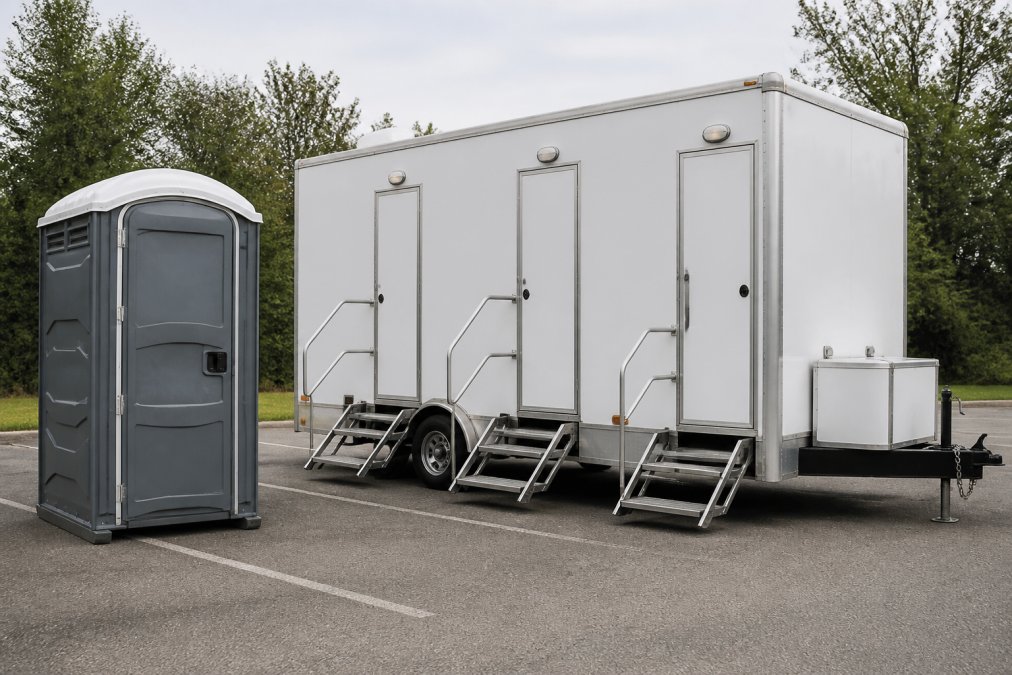
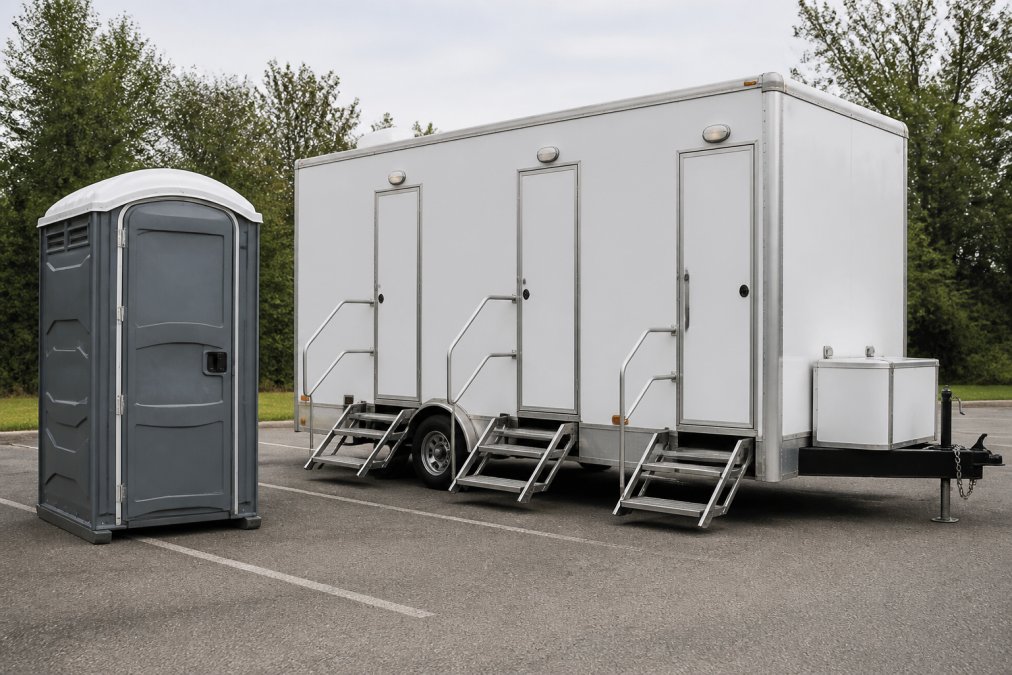
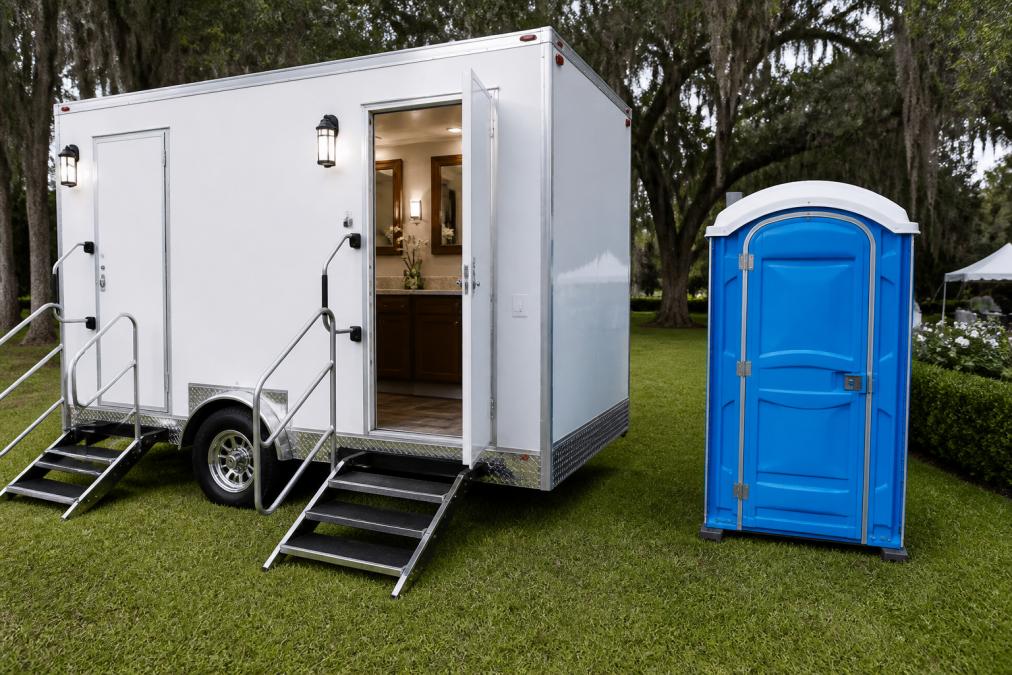
A portable toilet is a single-occupancy, self-contained sanitation unit with a holding tank, no running water, and no climate control. A restroom trailer is a towable, multi-stall facility with flushable toilets, freshwater sinks, interior lighting, and climate-controlled interiors that replicate indoor plumbing. One keeps a worksite compliant. The other keeps guests comfortable.
Here’s the side-by-side breakdown:
| Feature | Standard Portable Toilet | Restroom Trailer |
|---|---|---|
| Flushable toilets | No | Yes |
| Running water / freshwater sink | No | Yes |
| Climate control (heat/AC) | No | Yes |
| Interior lighting | Minimal | Full LED lighting |
| Vanity mirror | No | Yes |
| Laminate flooring | No | Yes |
| ADA-accessible option | Yes (specialized unit) | Yes |
| Holding tank capacity | ~60-70 gallons | Large, serviced tank |
| Towable / relocatable | Yes | Yes |
| Typical use case | Construction, utility | Weddings, events, emergencies |
| Footprint | Small (single unit) | Larger (trailer + tow vehicle) |
| Power supply required | No | Yes (electric hookup or generator) |
| Water hookup required | No | Typically yes, or onboard tank |
Restroom trailers require more site preparation and logistics. Portable toilets deploy faster. The right choice depends on event type, guest count, duration, and site accessibility.
Amenities, Space, and Site Requirements
Site requirements often determine which option is feasible. Confirm what your location can support before comparing amenities.
What a Standard Portable Toilet Provides
A standard portable toilet is a compact, single-occupancy unit with a holding tank, toilet seat, hand sanitizer dispenser, and vent stack for odor control. No running water, vanity mirror, or heating. The footprint is small, typically 4 feet by 4 feet, allowing flexible placement on gravel, grass, or pavement with minimal site preparation. No power or water hookup is needed.
Upgraded variants exist. ADA-compliant portable toilets include grab bars and meet federal accessibility standards. Deluxe flushing models add a freshwater hand-washing station and foot-pump flush mechanism. Construction projects accounted for 55% of overall portable toilet usage in 2024, reflecting the worksite-utility role these units fill best.
What a Restroom Trailer Provides
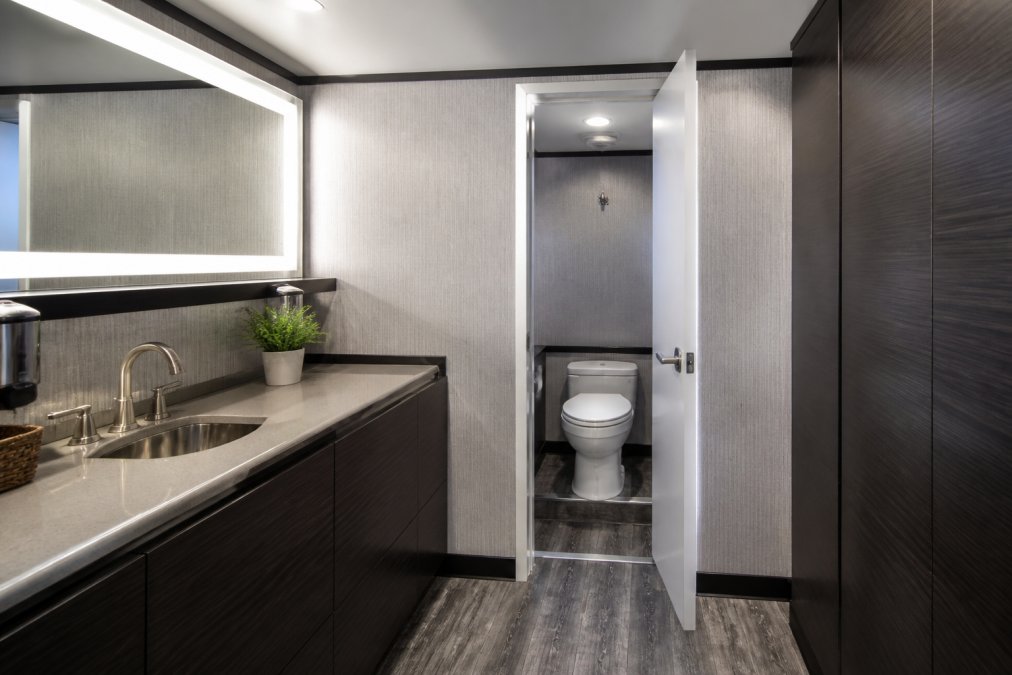
A restroom trailer resembles a well-appointed hotel restroom: decorative laminate flooring, LED lighting, vanity mirrors, private stalls with flushable toilets, and freshwater sinks. Climate-controlled interiors with heating and air conditioning work in summer heat and winter cold.
Trailers range from compact 2-stall configurations to large 8- or 10-station units serving hundreds of guests. The Royal Thrones Opulence line includes upscale finishes designed for weddings, festivals, and corporate events.
Site requirements are more involved. You’ll need a level surface for the trailer and tow vehicle, access to power (or a generator), and ideally a water hookup, though some trailers carry onboard freshwater tanks.
Request the trailer’s utility requirements in writing before booking: voltage, amperage, water pressure, and minimum clearance for the tow vehicle.
Luxury Restroom Trailer Rental Cost vs Portable Toilet Pricing
Cost comparisons require context. Raw price-per-unit comparisons mislead because the two products serve different needs.
Standard portable toilet rentals benchmark at $150-$325 per week nationally in 2026 for basic units, with deluxe flushing models at $200-$400 per week and ADA-compliant units at $245-$445 per week. Luxury restroom trailer rentals benchmark at $350-$825 per day for most 2-8 stall configurations in 2026.
The deeper consideration is guest experience and value. A 6-stall restroom trailer serving 200 guests often replaces eight to ten standard units, closing the cost gap considerably. According to Portable Restroom Trailer Market Research Report 2034, luxury restroom trailers held 38.4% of the global portable restroom trailer market in 2025, reflecting real demand from event planners who concluded that comfort-to-cost ratio favors trailers for events where guest experience matters.
“For rental business owners, durability is the foundation of your ROI. Breakdowns mean lost revenue and unhappy customers, so choosing units with advanced engineering matters more than the lowest upfront price.”
— Michelle Amelse, Vice President of Marketing and Customer Success at Satellite Industries (Satellite Industries Blog, 2025)
For current pricing on Royal Thrones restroom trailers, visit the Royal Thrones pricing page for a quick quote based on your event size and dates.
Don’t compare weekly portable toilet rates to daily trailer rates without converting to the same time period. The math looks dramatically different and leads to poor budget decisions.
How Many Portable Toilets Do I Need for an Event?
The standard planning formula is one portable toilet per 50 guests for events lasting up to four hours. Extend beyond four hours or add alcohol service, and that ratio tightens to one unit per 35-40 guests.
For restroom trailers, calculate by stalls. A 2-stall trailer handles approximately 75-100 guests comfortably for a 4-hour event. A 6-stall trailer covers 200-300 guests. An 8- or 10-stall configuration supports 400 or more.
For events under 50 guests lasting less than four hours, portable toilets typically make financial sense. Once you cross 100 guests or extend beyond six hours, the comfort-to-cost ratio shifts toward trailers. Events with 200 or more attendees often find that a 6-stall or 8-stall restroom trailer provides better value than coordinating a dozen portable toilets.
| Guest Count | Event Duration | Recommended Option | Minimum Stalls/Units |
|---|---|---|---|
| Under 50 | Under 4 hours | Portable toilet | 1-2 units |
| 50-100 | 4-6 hours | Portable toilet or 2-stall trailer | 2-3 units / 1 trailer |
| 100-200 | 4-8 hours | Restroom trailer | 4-stall trailer |
| 200-400 | Full day | Restroom trailer | 6-8 stall trailer |
| 400+ | Full day | Multiple trailers | 8-10+ stalls |
Two variables most planners underestimate: peak load periods and service frequency. A wedding cocktail hour creates concentrated rush that overwhelms under-provisioned sanitation fast. Build in 20% more capacity than the formula suggests for events with defined gathering moments.
ADA Compliant Portable Restroom Requirements
ADA compliance is not optional for public events or worksites. The Americans with Disabilities Act requires accessible sanitation facilities wherever temporary restrooms are provided.
An ADA-compliant portable restroom must provide sufficient interior space for wheelchair maneuverability: at least 60 inches wide with a 60-inch turning radius. Grab bars must be positioned on side and rear walls, with toilet seat height between 17 and 19 inches from the floor. Door hardware must be operable without tight grasping or twisting, and the door must open outward or slide to allow wheelchair access.
For restroom trailers, ADA-accessible stalls must meet the same dimensional and fixture requirements, with ramped or level entry. A trailer with steps and no ramp fails ADA compliance regardless of interior configuration.
Royal Thrones offers ADA-accessible restroom trailers designed to meet federal accessibility standards for events and temporary installations.
Always request written confirmation that the unit meets ADA requirements. “ADA-friendly” and “ADA-compliant” are not the same thing. The first is marketing; the second has a legal definition.
For complete federal requirements, the ADA Standards for Accessible Design provides authoritative specifications for temporary sanitation facilities.
Which Option Fits Your Situation: A Decision Framework
Matching the product to the context determines a good sanitation decision.
Construction Sites and Industrial Projects
Portable toilets are the standard for construction sites. Construction projects represented 55% of overall portable toilet usage in 2024. Rugged holding tanks handle heavy use, small footprints fit tight jobsites, and no power or water hookup is required.
For long-duration projects, servicing frequency matters most. OSHA guidelines require one toilet per 20 workers for projects with 20 or more employees, with daily servicing for high-use sites. A waste management schedule that keeps units clean and stocked prevents the most common complaints.
Restroom trailers have a place on construction sites for office trailers, extended remote projects, or facilities where management and clients need higher standards. Climate-controlled units with running water and heating improve productivity and retention for crews working in extreme temperatures.
Weddings, Formal Events, and Community Gatherings
Restroom trailers are the clear choice for weddings, formal events, and occasions where guest experience is part of the value proposition. The gap between a standard portable toilet and a climate-controlled trailer with laminate flooring, vanity mirror, and flushable toilets is immediate and noticeable.
For community gatherings and outdoor worship events, accessibility is equally compelling. Seniors, families with young children, and guests with mobility needs experience dramatically different events when restroom facilities include running water, climate control, and ADA-accessible stalls.
Maintenance, Servicing, and Environmental Considerations
Maintenance frequency separates good rental experiences from bad ones. Standard portable toilets on event sites require servicing every 1-3 days under normal use, and daily for high-traffic events. Each service cycle involves pumping the holding tank, restocking supplies, and sanitizing the interior.
Restroom trailers require similar waste management attention, but larger tank capacity and enclosed design reduce odor more effectively between service intervals. Climate-controlled interiors also inhibit bacterial growth, contributing to better hygiene over long events.
Waste from both portable toilets and restroom trailers is pumped to licensed treatment facilities. A restroom trailer serving 200 guests generates concentrated waste requiring a single scheduled pump-out, while a dozen portable toilets require multiple service vehicles and complex logistics. According to Satellite Industries’ guide to portable sanitation investment, IoT fill-level sensors and GPS-tracked dispatch increasingly shift servicing from fixed schedules to needs-based routes, reducing unnecessary truck rolls.
A site preparation checklist for either option:
- Confirm level ground with adequate drainage
- Verify access for delivery and service vehicles (minimum 10-foot clearance for trailers)
- Identify power supply location and confirm amperage for trailers
- Confirm water hookup availability or onboard tank capacity
- Establish a servicing schedule with the rental provider before the event
- Verify ADA-accessible unit placement meets path-of-travel requirements
- Confirm holding tank pump-out logistics for multi-day events
Choosing between a portable toilet and a restroom trailer rental is straightforward once you match the product to the context. Worksites need durable, low-infrastructure sanitation. Events need comfortable, climate-controlled facilities that reflect the hospitality standard your guests expect. Royal Thrones provides both, with a fleet including industrial-grade portable units and the full Opulence luxury line, all professionally maintained with 24-hour service availability and ADA-accessible configurations. Get a Quick Quote from Royal Thrones to confirm availability, stall count, and site requirements for your event or project.
=== FAQ ANSWERS (audit these too, same rules) ===
[1] Q: What are the primary differences between a standard portable toilet and a restroom trailer?
A: A standard portable toilet is a single-occupancy, self-contained unit with a holding tank, no running water, and no climate control. A restroom trailer is a towable structure with multiple private stalls, flushable toilets, freshwater sinks, vanity mirrors, laminate flooring, and heating and air conditioning. Restroom trailers require a power supply and sometimes a water hookup, while portable toilets need only a flat surface for placement. The interior space, amenities, and hygienic experience differ significantly between the two.
[2] Q: How does the cost of a portable toilet compare to a restroom trailer rental?
A: Standard portable toilet rentals benchmark at $150-$325 per week nationally in 2026, with ADA-compliant units running $245-$445 per week. Luxury restroom trailer rentals benchmark at $350-$825 per day for most 2-to-8-stall configurations. The cost gap is real, but restroom trailers serve more guests per unit, eliminate the need to manage many individual porta-potties, and deliver a substantially better guest experience. For current pricing specific to your event, visit the Royal Thrones pricing page or request a quick quote.
[3] Q: Are restroom trailers ADA compliant?
A: ADA-compliant restroom trailers are available and must meet the Americans with Disabilities Act standards, including a minimum 60-inch turning radius inside the stall, grab bars at specified heights, a door width of at least 32 inches clear, and accessible sink and fixture heights. Not every trailer on the market meets these standards automatically, so confirm ADA compliance with your provider before booking. Royal Thrones offers ADA-accessible restroom trailers; request photos or specs to verify the layout suits your specific accessibility needs.
[4] Q: How do I determine how many portable toilets or trailer stalls I need for my event?
A: A general rule for events: plan one toilet stall per 50 guests for events up to four hours. For events running six or more hours, increase that ratio. For 200-plus guests, a 6-to-8-stall restroom trailer often provides better throughput and guest flow than managing a dozen separate portable toilets. If alcohol is served, add roughly 20% more capacity. Construction sites typically require one unit per 10 workers for an eight-hour shift, per OSHA sanitation standards.
[5] Q: What amenities are included in a premium restroom trailer rental?
A: Premium restroom trailers typically include climate-controlled interiors with heating and air conditioning, private stalls with flushable toilets, freshwater sinks with running water, vanity mirrors, decorative laminate flooring, LED lighting, and premium soap and paper product dispensers. Higher-end units like the Royal Thrones Opulence line add upscale interior finishes, and configurations ranging from 2 to 10 stalls, making them suitable for weddings, corporate events, festivals, and facility emergencies alike.
Frequently Asked Questions
What are the primary differences between a standard portable toilet and a restroom trailer?
A standard portable toilet is a single-occupancy, self-contained unit with a holding tank, no running water, and no climate control. A restroom trailer is a towable structure with multiple private stalls, flushable toilets, freshwater sinks, vanity mirrors, laminate flooring, and heating and air conditioning. Restroom trailers require a power supply and sometimes a water hookup, while portable toilets need only a flat surface for placement. The interior space, amenities, and hygienic experience differ significantly between the two.
How does the cost of a portable toilet compare to a restroom trailer rental?
Standard portable toilet rentals benchmark at $150-$325 per week nationally in 2026, with ADA-compliant units running $245-$445 per week. Luxury restroom trailer rentals benchmark at $350-$825 per day for most 2-to-8-stall configurations. The cost gap is real, but restroom trailers serve more guests per unit, eliminate the need to manage many individual porta-potties, and deliver a substantially better guest experience. For current pricing specific to your event, visit the Royal Thrones pricing page or request a quick quote.
Are restroom trailers ADA compliant?
ADA-compliant restroom trailers are available and must meet the Americans with Disabilities Act standards, including a minimum 60-inch turning radius inside the stall, grab bars at specified heights, a door width of at least 32 inches clear, and accessible sink and fixture heights. Not every trailer on the market meets these standards automatically, so confirm ADA compliance with your provider before booking. Royal Thrones offers ADA-accessible restroom trailers; request photos or specs to verify the layout suits your specific accessibility needs.
How do I determine how many portable toilets or trailer stalls I need for my event?
A general rule for events: plan one toilet stall per 50 guests for events up to four hours. For events running six or more hours, increase that ratio. For 200-plus guests, a 6-to-8-stall restroom trailer often provides better throughput and guest flow than managing a dozen separate portable toilets. If alcohol is served, add roughly 20% more capacity. Construction sites typically require one unit per 10 workers for an eight-hour shift, per OSHA sanitation standards.
What amenities are included in a premium restroom trailer rental?
Premium restroom trailers typically include climate-controlled interiors with heating and air conditioning, private stalls with flushable toilets, freshwater sinks with running water, vanity mirrors, decorative laminate flooring, LED lighting, and premium soap and paper product dispensers. Higher-end units like the Royal Thrones Opulence line add upscale interior finishes, and configurations ranging from 2 to 10 stalls, making them suitable for weddings, corporate events, festivals, and facility emergencies alike.