Table of Contents
- Why Construction Sites Need Emergency Restroom Trailers
- Top Emergency Restroom Trailers: Quick Comparison
- Features That Define a Heavy-Duty Construction Restroom Trailer
- Understanding OSHA Portable Toilet Requirements for Crew Size
- ADA-Compliant Restroom Trailer Rental: What to Check
- Utility Hookups and Site Prep for Emergency Deployment
- Trailer vs. Standard Porta-Potty: A Cost-Benefit Analysis
- Which Emergency Restroom Trailer Should You Pick?
- Frequently Asked Questions
Last Updated: September 6, 2026
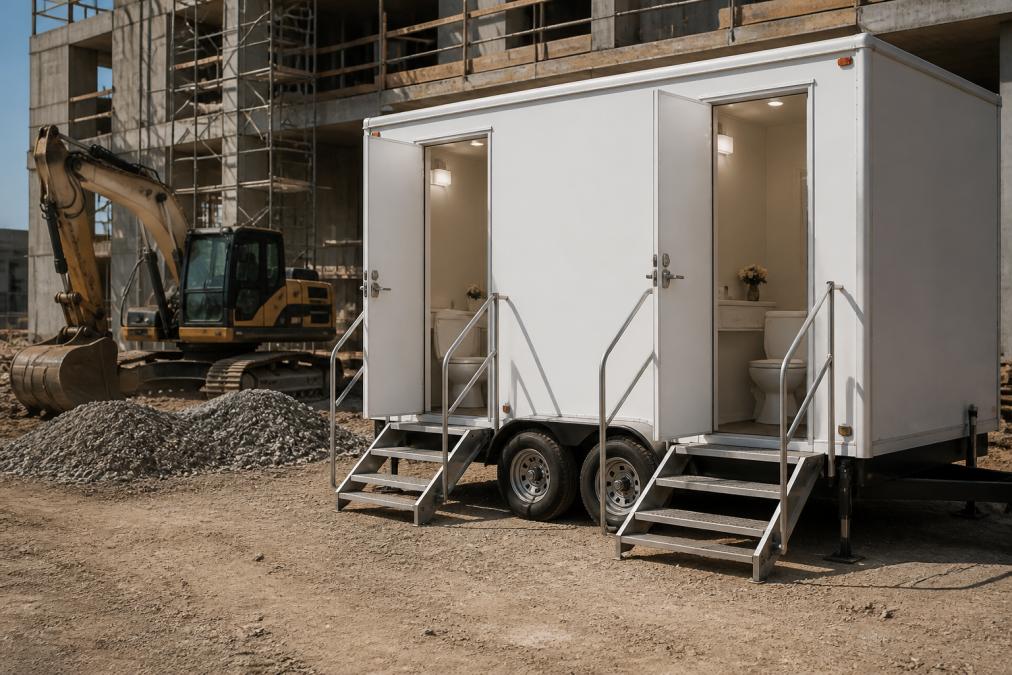
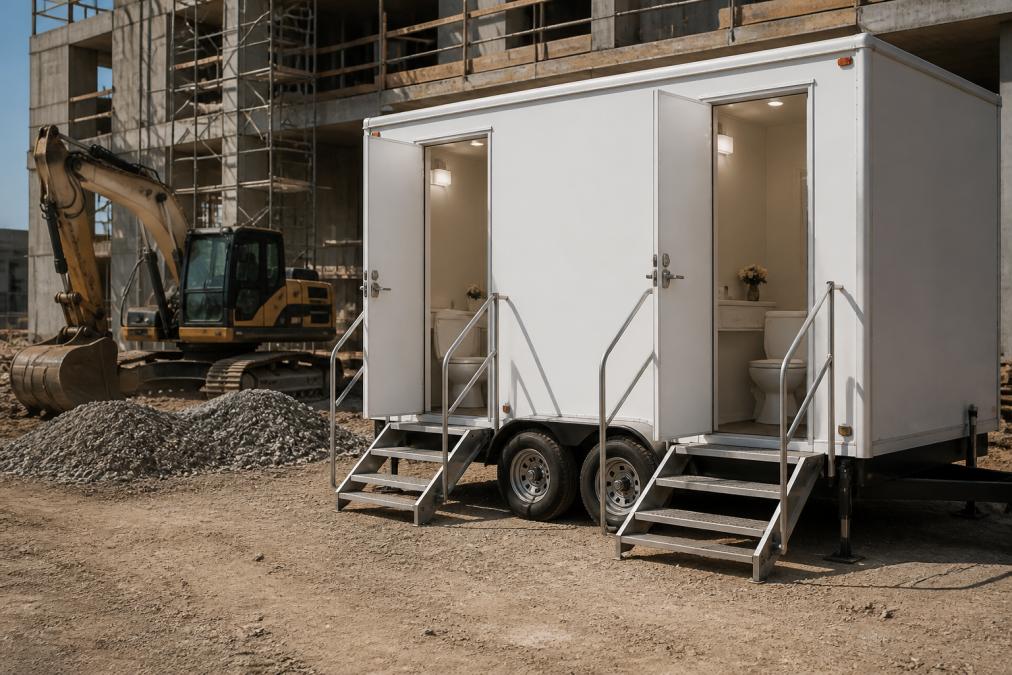
The portable restroom trailer market was valued at $1.8 billion in 2025 and is projected to reach $3.1 billion by 2034, according to Dataintelo’s 2025 market valuation report. That growth reflects a fundamental shift in how construction managers think about job site sanitation. An emergency restroom trailer for construction sites isn’t just a compliance box to check; it’s the difference between a crew that stays on schedule and one that loses productive hours to inadequate facilities. Below, we’ll show you exactly how to evaluate, size, and deploy the right emergency restroom trailer for construction sites, covering the features, compliance standards, and cost realities that actually matter.
Why Construction Sites Need Emergency Restroom Trailers
Construction sites account for 35% of the portable toilet rental market share, while emergency response and other niche applications make up 20%, per Global Insight Services’ 2026 market analysis. Those numbers make sense when you consider what’s at stake. When a restroom fails on a remote site or during a heat wave, the entire operation stalls. Workers need accessible, climate-controlled facilities that hold up under heavy daily use, not just a plastic booth baking in the sun.
The industry is moving toward professionalized, climate-controlled units that reduce health hazards and improve site morale, as noted by ETP LLC’s 2026 industry analysis. A 4-stall restroom trailer configuration supports 200 to 350 workers on medium-sized construction projects, according to Restroom Resources’ capacity planning guide. That’s the scale where a single standard porta-potty stops being viable.
Top Emergency Restroom Trailers: Quick Comparison
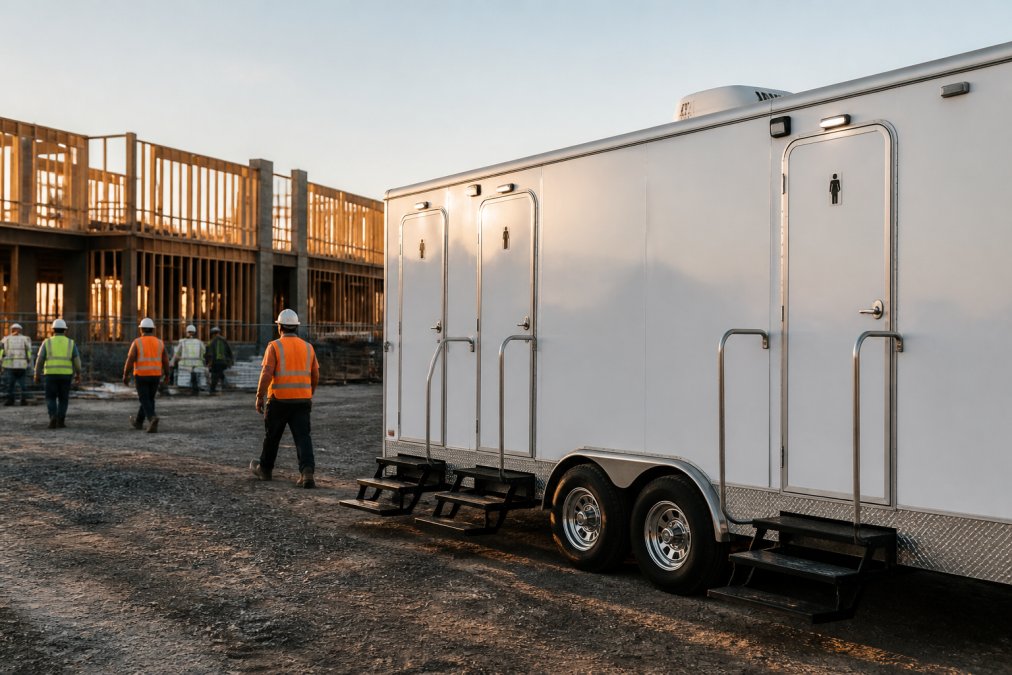
For this guide, we evaluated the leading options based on capacity, durability, compliance, and deployment speed. Royal Thrones offers a diverse fleet including industrial-grade units for active sites and ADA-compliant options, all with running water, heating, and air conditioning. This combination is important when a site requires rapid deployment.
| Trailer Option | Configuration | Best For | Key Feature |
|---|---|---|---|
| Royal Thrones | 2 to multi-station | Emergency deployment | 24-hour service, climate control |
| 9-station | High-traffic sites | Climate-controlled interior | |
| Multi-stall | Daily heavy use | Rugged, easy-clean surfaces | |
| Potty Girl | Restroom + shower | Disaster relief | High-capacity waste tanks |
| Custom | Remote locations | Heavy-duty off-road chassis |
Features That Define a Heavy-Duty Construction Restroom Trailer
A heavy-duty construction restroom trailer is a mobile sanitation unit built with industrial-grade materials, high-capacity waste systems, and climate control to withstand continuous use on active job sites. The interior needs slip-resistant flooring, flushable toilets, and handwashing stations with running water. A 10-station restroom trailer typically provides approximately 3,400 uses before requiring service, according to Potty Girl’s capacity planning data. That translates to fewer service interruptions and less downtime for your crew.
What most guides miss is the difference between event-grade and construction-grade units. Event trailers prioritize aesthetics; construction trailers prioritize durability. Look for reinforced exteriors, easy-to-clean surfaces, and waste tanks sized for extended deployment between service visits.
When evaluating units, ask about holding tank capacity relative to your crew size. A trailer that needs daily pumping on a remote site will eat your budget in service calls faster than you expect.
Understanding OSHA Portable Toilet Requirements for Crew Size
OSHA portable toilet requirements mandate specific restroom ratios based on crew size, and construction managers must also meet ADA accessibility standards, according to the Satellite Industries guide on OSHA compliance. The general rule: 1 toilet seat and 1 urinal per 10 workers for sites with 20 or more employees, with additional units required as crew size grows. For sites under 20 workers, the ratio adjusts to 1 toilet per 20 workers.
These aren’t suggestions; they’re enforceable standards. A crew of 150 workers needs at least 8 toilet seats and 8 urinals under the standard ratio. That’s where a multi-stall restroom trailer becomes the practical solution, keeping you compliant without scattering dozens of individual porta-potties across the site.
Under-provisioning restrooms isn’t just a morale problem. OSHA inspectors can cite your site for inadequate sanitation facilities, and the resulting fines and work stoppages will cost far more than the trailer rental.
ADA-Compliant Restroom Trailer Rental: What to Check
An ADA-compliant restroom trailer rental must include specific accessibility features that meet federal standards, not just a wider door. Check for proper turning radius for wheelchairs, grab bars positioned at the required heights, and sink and toilet heights within accessible ranges. The Portable Restroom Trailers ADA compliance specifications outline the key configuration details, including integrated shower options and solar-powered configurations for off-grid compliance.
Before you commit to an ADA-compliant restroom trailer rental, verify the actual layout. Ask for photos or specs showing the interior dimensions, and if possible, arrange a site visit to confirm the unit works for someone in a wheelchair.
Utility Hookups and Site Prep for Emergency Deployment
Emergency deployment of a restroom trailer hinges on three utility connections: fresh water supply, waste water removal, and electrical power. Most construction-grade trailers use standardized connections, but the failure point is almost always the site’s infrastructure, not the trailer itself.
Fresh Water Supply
The most common hookup is a standard garden hose connection (typically 3/4-inch) to a potable water spigot. However, for a multi-stall trailer supporting 200+ workers, a 3/4-inch line may not provide adequate pressure or flow rate. For high-demand sites, request a trailer with a 1-inch or larger supply line connection. You will also need a backflow preventer to keep site water safe and compliant with local codes.
Waste Water Removal
Waste water is handled in one of two ways: a direct sewer connection or an onboard holding tank. A direct connection to a sanitary sewer is the most cost-effective and requires minimal daily oversight, but it requires the site to have a sewer cleanout within reach of the trailer’s waste outlet (usually a 3-inch or 4-inch hose). If no sewer is available, the trailer’s holding tank becomes your primary constraint. For example, a 10-station trailer might have a 1,500-gallon black water tank, which with a crew of 150 might need pumping every 3 to 4 days.
Electrical Power
Most restroom trailers require a 30-amp or 50-amp, 120/240-volt electrical service to run climate control, lighting, and water heaters. A standard 120-volt, 20-amp outlet is insufficient for a unit with air conditioning running during a summer heat wave. You have three options: a dedicated site power pedestal, a generator, or a solar-powered configuration. For emergency deployments where grid power is down, a diesel generator is the most reliable, but it adds noise and fuel costs. Before the trailer arrives, confirm the amperage and plug type (e.g., NEMA TT-30 or NEMA 14-50).
Site Preparation Checklist
Beyond the hookups, the physical placement of the trailer is critical. Use this checklist during your pre-deployment walkthrough:
- Level Ground: The trailer must be parked on ground that is level within a few degrees. An unlevel trailer can cause plumbing issues and make doors stick. Request a site survey if the area is sloped.
- Access for Delivery: Ensure the delivery truck has a clear path with at least 14 feet of vertical clearance and a solid surface that can support the weight of the truck and trailer (often exceeding 20,000 pounds).
- Proximity to Workers: Place the unit within a 5-minute walk of the main work area to minimize time away from tasks, but keep it far enough from heavy equipment paths to avoid damage.
- Service Vehicle Access: Leave at least 20 feet of clearance on the service side of the trailer for the pump truck’s hoses.
Do not assume a standard extension cord will power a restroom trailer. An undersized cord or incorrect voltage can damage the unit’s electrical system and void your rental agreement. Always verify the power source amperage and plug configuration with your electrician before the trailer arrives.
For large-scale infrastructure projects, such as data centers, facilities often need to support 500 to 2,000 workers, according to Portable Restroom Trailers’ capacity analysis. At that scale, utility planning becomes a project in itself, often requiring a dedicated coordination meeting between the site superintendent, the electrical contractor, and the sanitation provider to map out water distribution and waste pump-out schedules.
Trailer vs. Standard Porta-Potty: A Cost-Benefit Analysis
The decision between a restroom trailer and a standard porta-potty is often framed as a simple cost-per-unit comparison, but that misses the full picture. The real analysis is about total cost of ownership, worker productivity, and regulatory risk.
The Direct Cost Comparison
A standard porta-potty rental typically costs between $100 and $250 per month per unit. A basic restroom trailer rental starts at approximately $1,000 to $1,500 per month for a small 2-stall unit, scaling up to $3,000 or more for a large, climate-controlled 10-stall trailer. The comparison changes when you account for the number of units required and the service costs.
For a crew of 100 workers, OSHA standards require roughly 10 toilet seats and 10 urinals. Meeting that with standard porta-potties means renting 10 to 15 units, which at the high end costs around $3,750 per month. A single 10-stall restroom trailer, which can serve up to 350 workers, costs less than that and provides a higher level of service.
The Hidden Cost of Worker Downtime
A worker who has to walk 10 minutes to a porta-potty, wait in line, and then walk back is losing 20 to 30 minutes of productive time. On a site with 100 workers, if each worker makes two trips per day, that is 40 to 100 lost labor hours daily. At a blended labor rate of $40 per hour, that is $1,600 to $4,000 per day in lost productivity.
Improved sanitation facilities directly correlate with worker retention and morale. The cost of recruiting and onboarding a replacement worker on a skilled trade can easily exceed $5,000, so reducing turnover by even one or two workers can offset the entire premium of a trailer rental for a month.
When the Math Favors Porta-Potties
It is not always the right choice. For a short-term project lasting less than a month with a crew under 20 workers, the logistics and cost of a trailer are hard to justify. Similarly, if the site has no access to water, power, or sewer, and the cost of a service truck to fill and pump a trailer is prohibitive, porta-potties with their self-contained tanks may be the only viable option.
A Simple Decision Framework
Use this framework to guide your decision:
- Project Duration < 1 month: Standard porta-potties are usually sufficient.
- Project Duration > 3 months, Crew > 50: A restroom trailer is likely the better investment, as the per-day cost becomes competitive and the productivity benefits compound.
- Remote Site with No Utilities: Factor in the cost of a service truck for water delivery and waste pumping. If that cost exceeds $500 per visit, a trailer with larger tanks may still be viable, but a porta-potty with a larger holding tank might be simpler.
- High-Profile or Client-Facing Site: A trailer presents a more professional image and can be a differentiator when bidding on contracts.
When presenting the budget to your project manager, do not just compare rental rates. Present the total cost of ownership, including service calls, and the estimated productivity gain from reduced walking and waiting time. In most long-term scenarios, the trailer pays for itself.
The math changes with project duration. Small business owners in the mobile restroom trailer industry often break even within 6 to 12 months, according to FoodMax Machines’ business profitability analysis. For a construction manager, that translates to a simple question: if your project runs longer than a few months and employs more than 50 workers, the per-day cost of a trailer becomes competitive with the logistics of managing dozens of individual porta-potties.
Which Emergency Restroom Trailer Should You Pick?
The right emergency restroom trailer for construction sites depends on three variables: crew size, project duration, and site infrastructure. For anything larger, longer, or more remote than a short-term project with under 50 workers, a climate-controlled trailer with running water is the better investment.
Royal Thrones offers a fleet that spans industrial-grade units for active sites through to premium options, all backed by 24-hour service. When something breaks down on a remote site, response speed matters as much as the equipment itself.
For large-scale projects requiring facilities for 500 to 2,000 workers, plan for multiple units and a scheduled service rotation. The upfront cost of adequate sanitation is always lower than the cost of a compliance citation or a crew that walks off the job.
Frequently Asked Questions
How many restroom trailers do I need for a construction site of 200 workers?
For a crew of 200 workers, OSHA portable toilet requirements generally mandate at least one toilet seat and one urinal per 40 employees. A single 4-stall restroom trailer typically supports 200 to 350 workers on medium-sized projects, so one unit may suffice. For larger crews or sites spread over a wide area, you may need multiple units or a higher-capacity trailer. Site logistics, shift changes, and the distance workers travel from active areas all affect the final count.
What is the difference between a restroom trailer and a standard porta-potty for construction?
Restroom trailers provide running water, flushable toilets, handwashing stations, and climate control, which standard porta-potties lack. For long-term or high-density projects, trailers reduce health hazards and improve worker morale, supporting better hygiene compliance. Standard units are cheaper upfront and suit small, short-term sites. However, trailers offer a lower cost per use over extended rentals, especially when factoring in the reduced servicing frequency. A 10-station trailer can handle roughly 3,400 uses before needing service.
Are emergency restroom trailers climate-controlled for year-round use?
Yes. Most emergency restroom trailers for construction sites include heating and air conditioning as standard equipment. This protects workers from extreme heat and cold, which is critical for maintaining site morale and preventing heat-related illness. Climate control also keeps plumbing functioning in winter when properly winterized. If your site experiences freezing temperatures, confirm the rental provider offers winterization protocols to protect the fresh water tank and waste systems from damage.
How often should construction site restroom trailers be serviced?
Servicing frequency depends on usage, but a 10-station trailer typically requires attention after approximately 3,400 uses. For a crew of 200 workers, that often translates to servicing every one to two weeks. High-traffic sites may need weekly waste disposal, fresh water refills, and interior cleaning. Ask your rental provider about their preventative maintenance schedule and emergency response times. A provider offering 24-hour service can address issues quickly, minimizing downtime and maintaining sanitary standards on site.
What utility hookups does an emergency restroom trailer require?
Most restroom trailers require three connections: a water supply line, a power hookup (typically 30 or 50 amp), and a waste drainage line or holding tank. Some units operate off-grid with large fresh water tanks and onboard waste storage for remote sites. Before delivery, confirm the trailer’s requirements match your site’s available utilities. If hookups are not available, ask about off-grid configurations with larger holding tanks and generator power options to maintain full functionality.
Choosing the right sanitation solution for your construction site comes down to crew size, project timeline, and the conditions your team works in. Royal Thrones combines climate-controlled units, ADA-compliant options, and 24-hour service to keep your site operational and compliant, whether you’re managing a routine build or responding to an emergency. Get a Quick Quote and see how our fleet supports your next project.