
Select Page

Table of Contents

Last Updated: September 13, 2026

What to Look for in an Accessible Shower Trailer Provider

Accessible shower trailers are mobile hygiene units with ADA-compliant ramps, wide doors, and roll-in private shower suites. Finding the right provider starts with three checks: verified ADA features, climate control, and genuine 24/7 service.

Emergency relief efforts are a primary application sector for portable shower trailer rentals in 2026, alongside construction sites and outdoor events, according to Shower Trailers Rentals Market Size 2026 analysis. Average rental pricing runs roughly $1,500 to $3,000 per unit per week, and luxury configurations account for about 20% of total rental revenue.

At Royal Thrones, every quote starts with the question emergency managers ask first: will the unit work for the person who needs it most?
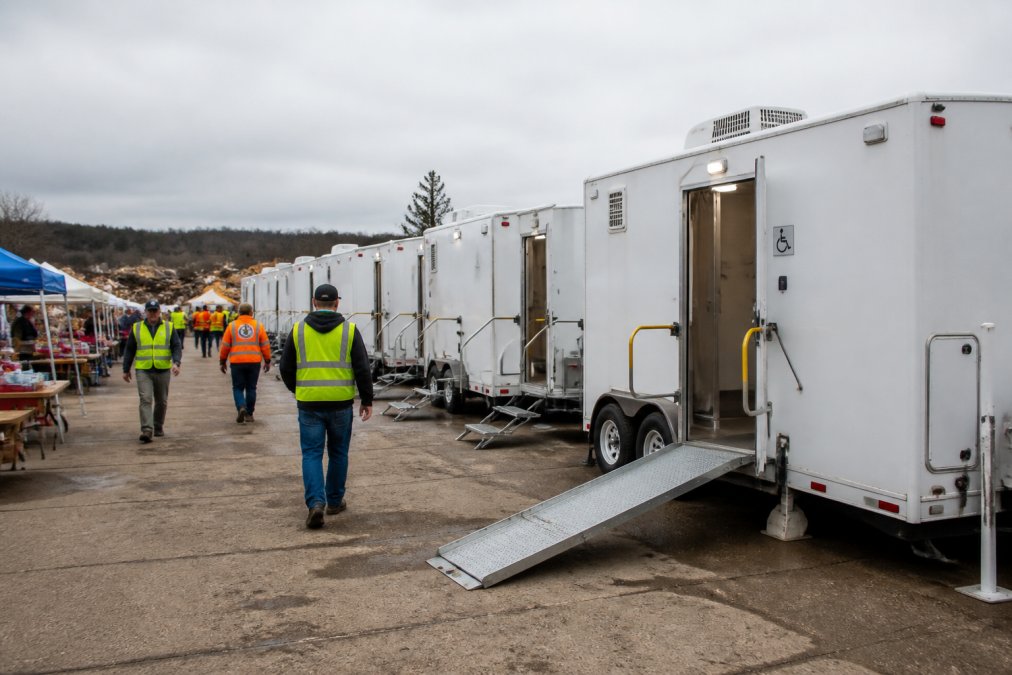
A row of clean, modern accessible shower trailers parked at a disaster relief staging area, with volunteers in safety vests walking between units and a clear ADA ramp visible on the nearest trailer

ADA Ramp Access and Private Shower Suites

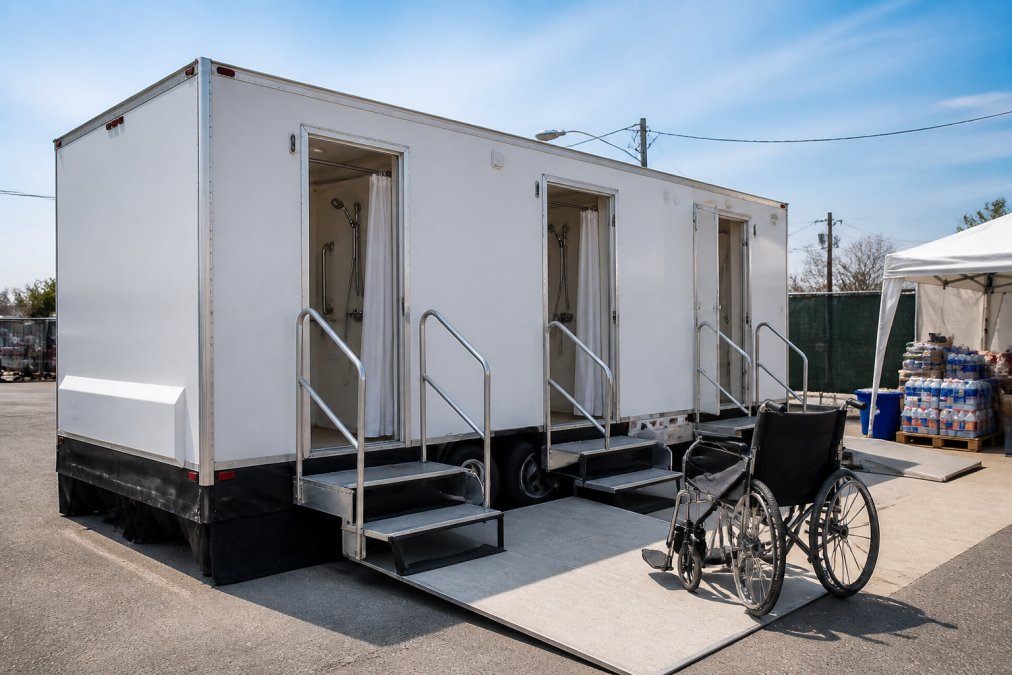
A compliant unit pairs a ramp with a private shower suite that a wheelchair user can enter, turn, and use without assistance. Multiple providers have standardized wide entry doors, ramps, and spacious interiors for disaster relief fleets, according to VIP To Go and Royal Restrooms fleet standards. Ask for the ramp slope, door width, and interior turning radius in writing before you sign.

Climate Control and 24/7 Availability

Heat and cold drive hygiene emergencies as fast as floods do. Climate-controlled units with running water, heating, and air conditioning keep showers usable when temperatures spike or drop. Confirm two things in the contract: the unit’s power requirement and the provider’s after-hours response window.

Pro Tip
Ask whether the provider keeps a dedicated disaster relief fleet or pulls from general event inventory. Fleets reserved for emergency response are staged and prepped year-round, so they deploy faster when a storm makes landfall.

ADA-Compliant Shower Trailer Rental Requirements

ADA-compliant shower trailer rental requirements cover three measurable areas: door width and ramp access, interior turning radius, and fixture heights. Every requirement is verifiable on a spec sheet, and any provider should hand those specs over before you commit. What most guides skip is translating specs into a station count that serves your headcount.

Door Width, Turning Radius, and Fixture Heights

Use this as a request-for-specs checklist and ask the provider to return each line in writing for the exact unit assigned to your deployment:

  • Entry door clear width sufficient for a standard adult wheelchair, checked against the current ADA Standards for Accessible Design
  • A 60-inch turning circle inside the shower suite
  • Grab bars mounted at compliant heights, with a roll-in or transfer shower configuration
  • A ramp with edge protection and a stable, non-slip surface
  • A shower seat and a handheld sprayer with a hose long enough to reach the seat
  • Controls, dispensers, and hooks mounted within reach range from a seated position
  • An accessible route from the trailer door to the shower suite that stays clear of curbs, cables, and standing water

The ADA Standards for Accessible Design set the baseline for these measurements, and the 2010 Standards remain the enforceable reference for new construction and alterations. For a temporary event or disaster facility, the relevant question is not whether the trailer was built to code but whether the specific configuration you are renting meets the same measurements.

How to Verify a Trailer Meets ADA Compliance

Verification is a paperwork exercise, not a trust exercise. Request the manufacturer’s spec sheet, photos of the actual unit assigned to your deployment, and the maintenance log. If a provider hesitates on any of the three, treat that as your answer.

ADA compliance is configuration-specific. A provider can own compliant trailers and still send a standard unit if you don’t specify accessibility in the contract. Put “ADA-accessible configuration” in the rental agreement, attach the spec sheet as an exhibit, and name the exact unit number.

Sizing Stations to Headcount: A Throughput Model

Accessibility specs tell you whether a unit works for one person; throughput tells you whether it works for your population. Size fleets with a simple model:

  1. Estimate peak hourly demand. Assume each displaced person showers once every 24 to 48 hours, compressed into a peak window (typically morning and evening). If 400 people need showers and half use them in a four-hour evening window, that is about 50 showers per hour.
  2. Apply a per-station cycle time. A private shower suite turns over in roughly 10 to 15 minutes including entry, undressing, showering, and exit, about 4 to 6 showers per station per hour.
  3. Divide peak demand by per-station throughput. Fifty showers per hour divided by 5 per station per hour equals about 10 stations running at peak.
  4. Add an accessibility buffer. Because accessible suites serve users who take longer, add 20 to 30 percent more stations than the raw math suggests.

Worked example: 400 displaced residents, a four-hour peak window, and a 12-minute cycle time produce about 50 showers per hour. At 5 showers per station per hour, that is 10 stations minimum, or 12 to 13 with an accessibility buffer. Two 6-station trailers cover that load; a single 4-station trailer does not.

Pro Tip
Ask the provider for their published per-station throughput figure and the assumptions behind it. A vendor who can explain the math will also tell you when your headcount requires a second trailer, which is the answer you actually want before a storm makes landfall.

Matching Unit Type to Population

Match the unit class to who is being served:

  • ADA combo trailers pair one accessible suite with standard stalls and work well for mixed populations where a small share of users need accessibility.
  • All-accessible multi-station trailers dedicate every suite to roll-in or transfer access and suit shelters serving higher-need populations, such as assisted-living evacuees or patients in medical respite.
  • Family and private-suite configurations reduce queuing when children, elderly residents, or trauma-affected populations need privacy and caregiver assistance.

Document the population profile in your requirements before requesting quotes; a provider cannot size a fleet correctly against headcount alone.

Portable Shower Trailer Site Preparation Guide

Site preparation determines whether your portable shower trailer works on day one or stalls at the gate. Assess three failure points, utilities, ground conditions, and access routes, before the trailer arrives.

Water Hookups, Power Requirements, and Waste Management

Plan for four connections: a fresh water tank or potable water hookup, a power source sized to the unit’s load, gray water disposal, and a waste tank pump-out schedule.

Build your utility plan around these items:

  • Confirm potable water access or fresh water tank capacity and refill cadence
  • Verify generator or shore power meets the trailer’s amperage draw
  • Identify gray water disposal or holding tank capacity
  • Schedule waste pump-out frequency based on headcount
  • Confirm handwash stations and laundry trailer integration points if needed

Level Ground, Access Routes, and Placement Tips

Pick a level, compacted pad within reach of utilities, with a clear tow-vehicle path and room for the ramp to deploy. Keep the ADA ramp side clear of standing water and vehicle traffic. Place the unit downwind of food service and upwind of waste staging.

Get a Quick Quote →

Watch Out
Skipping the site assessment is the most expensive mistake in emergency deployment. If the pad is soft or the power run is too long, the trailer sits idle while responders wait in line for showers.

Cost Factors for Emergency Shower Trailer Rentals

Cost factors for emergency shower trailer rentals come down to four variables: unit capacity, delivery distance, rental duration, and luxury versus industrial finishes. Get quotes itemized by each variable, not as a lump sum.

Unit Capacity, Delivery Distance, and Rental Duration

Capacity drives everything: a single-station ADA combo trailer serves far fewer users per hour than a multi-station unit, so match station count to headcount and peak usage windows. Longer rentals lower the per-day rate; delivery distance adds fuel, labor, and mobilization fees.

Factor What Drives Cost How to Control It
Unit capacity Station count, ADA combo vs. multi-station Match stations to peak hourly demand
Delivery distance Fuel, labor, mobilization Stage units closer to the site
Rental duration Daily vs. weekly vs. monthly rate Commit to longer terms when possible
Unit class Luxury finishes vs. industrial build Choose industrial for relief, luxury for events

Luxury vs. Industrial Units: What Drives the Price

Luxury trailers carry premium fixtures, finished interiors, and higher build costs. Industrial units prioritize durability, easy sanitation, and fast turnaround.

For emergency relief, industrial builds usually win on value. Luxury makes sense when the deployment doubles as community outreach or temporary housing support for displaced families.

How to Reserve Emergency Relief Shower Trailers

Reserving emergency relief shower trailers follows a procurement path, not a phone call. These five steps keep accessibility, utilities, and timelines aligned.

The Five-Step Reservation Sequence

  1. Define your requirements. Headcount, peak usage window, deployment length, accessibility profile, and whether you need all-accessible or mixed configurations.
  2. Request ADA specs in writing. Door width, turning radius, ramp slope, and fixture heights for the exact unit number, attached to the contract as an exhibit.
  3. Complete the site assessment. Utilities, ground conditions, and access routes documented before booking, with photos of the pad and utility tie-in points.
  4. Confirm service terms. 24/7 availability, maintenance response time, pump-out schedule, and who supplies the water and power.
  5. Lock the delivery window. Get arrival, setup, and teardown times in the contract, plus a named on-site contact on both sides.

Funding and Cost Recovery for Public Agencies

Emergency managers rarely pay for relief trailers from a standing line item. The money usually comes from one of four sources, and knowing which applies before you call a vendor changes the paperwork you need:

  • Federal disaster assistance. After a presidential disaster declaration, FEMA’s Public Assistance program can reimburse eligible emergency protective measures, commonly including temporary sanitation and hygiene facilities for shelters and staging areas. Reimbursement is generally cost-share based, so document every invoice, delivery ticket, and pump-out receipt from day one.
  • State and local emergency funds. Many state emergency management agencies maintain pre-positioned contracts or rapid-purchase authorities that let counties and cities rent without a full competitive solicitation during an active event.
  • Mutual aid and cooperative purchasing. Cooperative purchasing organizations and state master contracts let agencies piggyback on pre-negotiated terms, shortening the time between request and delivery.
  • Grant programs and nonprofit partners. Public health preparedness grants and disaster relief nonprofits sometimes fund hygiene infrastructure directly, particularly for shelters serving medically fragile populations.
Watch Out
Reimbursement rules require documentation that matches the event timeline. Keep the disaster declaration number, the mission assignment or purchase order, the vendor invoice, and the delivery and pickup tickets together in one file. Missing paperwork is the most common reason a legitimate expense gets denied.

Contracting Vehicles: GSA Schedules and Emergency Procurement

For government and military applications, ask whether the provider can work through a GSA schedule or existing emergency procurement channel. That can cut weeks off deployment, because it lets you issue a task order against vetted terms instead of running a new solicitation.

When you evaluate a provider’s contracting capability, ask for:

  • Their GSA contract number and the special item numbers that cover shower and restroom trailers
  • Whether they have prior experience with emergency procurement or sole-source justification
  • Their capacity to provide itemized invoices that separate rental, delivery, setup, pump-out, and consumables
  • A certificate of insurance and any required bonding documentation on file
  • Their ability to sign a mutual aid or standby agreement before an event, not during one

Building a Standby Vendor Shortlist

The agencies that deploy fastest did the contracting work before the event. Identify two or three providers with accessible fleets, verify their ADA specs and contracting vehicles, and put a standby agreement or pre-negotiated rate sheet in place each year before storm season.

Key Takeaway
The providers that deploy fastest are the ones you’ve already vetted and already have under contract. Build your vendor shortlist and your funding file before storm season, not during it.

Winterization and Extreme Weather Operation for Shower Trailers

Winterization and extreme weather operation protect the two systems most likely to fail: water lines and power. Freeze protection, insulation, and a backup heat source keep a trailer operational below freezing.

Drain and winterize fresh water tanks between deployments, insulate exposed lines, and confirm the heating system runs independently of the primary power source. In extreme heat, verify the air conditioning load against generator capacity, a unit that trips the breaker mid-shower creates a public health problem fast.

Maintenance matters more in extreme conditions, not less. Schedule pre-deployment inspections and keep spare parts for pumps, heaters, and door hardware on hand.

Conclusion

Emergency hygiene logistics fail for predictable reasons: unverified ADA specs, unassessed sites, and providers without after-hours support. Royal Thrones maintains a fleet of climate-controlled, ADA-accessible restroom and shower trailers with 24-hour service and well-lit interiors, built for disaster relief and community events. Our team can walk you through unit specs, site requirements, and delivery logistics before you commit. Get a quick quote from Royal Thrones and lock in accessible sanitation before the next deployment window opens.

Frequently Asked Questions

How much does it cost to rent a portable shower trailer for emergency relief?

Pricing depends on unit size, rental duration, delivery distance, and whether you need ADA-accessible configurations. For a specific quote on accessible shower trailers, request pricing directly from your provider based on your site and timeline.

What are the ADA requirements for emergency shower trailers?

ADA-compliant shower trailers must have a 32-inch minimum clear door width, a 60-inch turning radius inside the shower suite, grab bars, a fold-down shower seat, and controls reachable from a seated position. Ramps must have a 1:12 slope with edge protection. Providers now standardize wide entry doors and ramps across their disaster relief fleets to meet these requirements.

How far in advance should I reserve emergency relief shower trailers?

For planned disaster relief deployments, reserve at least two to four weeks ahead to secure ADA-accessible units and confirm delivery logistics. During active emergency response, availability tightens quickly, so contact providers immediately.

What power and water requirements do accessible shower trailers need?

Most accessible shower trailers need a standard 120V or 220V power connection for lighting, climate control, and water heaters, plus a potable water hookup or onboard fresh water tank. Gray water and black water tanks require scheduled pump-out service. If site utilities are not available, providers can supply generators and water tanks, but these add to cost and require pre-deployment planning.
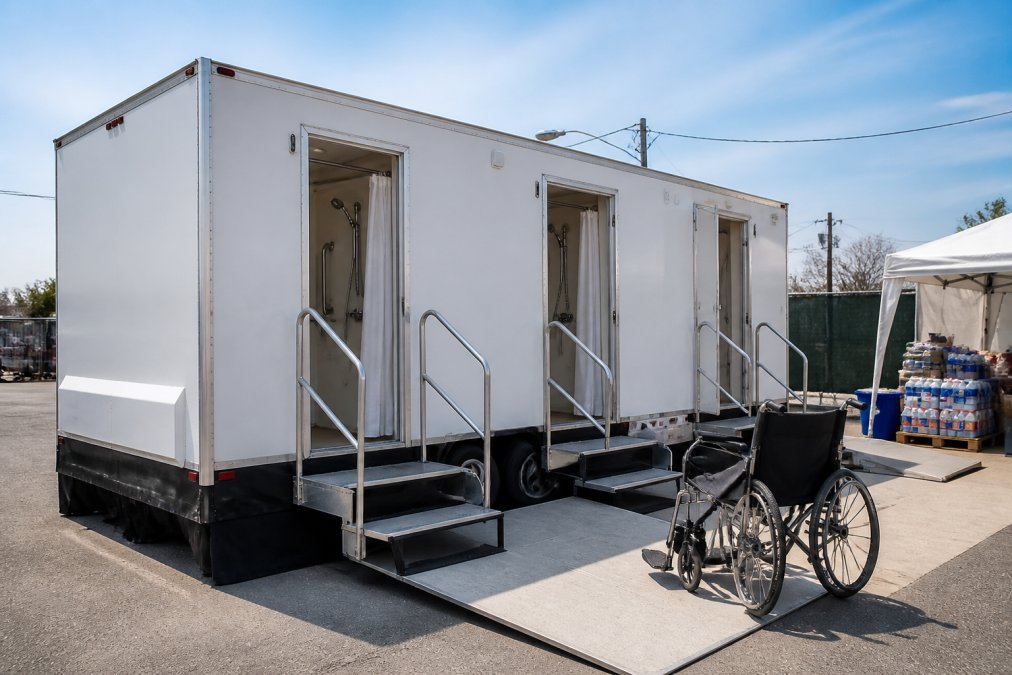
Table of Contents

Last Updated: September 13, 2026

What to Look for in an Accessible Shower Trailer Provider

Accessible shower trailers are mobile hygiene units with ADA-compliant ramps, wide doors, and roll-in private shower suites. Finding the right provider starts with three checks: verified ADA features, climate control, and genuine 24/7 service.

Emergency relief efforts are a primary application sector for portable shower trailer rentals in 2026, alongside construction sites and outdoor events, according to Shower Trailers Rentals Market Size 2026 analysis. Average rental pricing runs roughly $1,500 to $3,000 per unit per week, and luxury configurations account for about 20% of total rental revenue.

At Royal Thrones, every quote starts with the question emergency managers ask first: will the unit work for the person who needs it most?

A row of clean, modern accessible shower trailers parked at a disaster relief staging area, with volunteers in safety vests walking between units and a clear ADA ramp visible on the nearest trailer

ADA Ramp Access and Private Shower Suites

A compliant unit pairs a ramp with a private shower suite that a wheelchair user can enter, turn, and use without assistance. Multiple providers have standardized wide entry doors, ramps, and spacious interiors for disaster relief fleets, according to VIP To Go and Royal Restrooms fleet standards. Ask for the ramp slope, door width, and interior turning radius in writing before you sign.

Climate Control and 24/7 Availability

Heat and cold drive hygiene emergencies as fast as floods do. Climate-controlled units with running water, heating, and air conditioning keep showers usable when temperatures spike or drop. Confirm two things in the contract: the unit’s power requirement and the provider’s after-hours response window.

Pro Tip
Ask whether the provider keeps a dedicated disaster relief fleet or pulls from general event inventory. Fleets reserved for emergency response are staged and prepped year-round, so they deploy faster when a storm makes landfall.

ADA-Compliant Shower Trailer Rental Requirements

ADA-compliant shower trailer rental requirements cover three measurable areas: door width and ramp access, interior turning radius, and fixture heights. Every requirement is verifiable on a spec sheet, and any provider should hand those specs over before you commit. What most guides skip is translating specs into a station count that serves your headcount.

Door Width, Turning Radius, and Fixture Heights

Use this as a request-for-specs checklist and ask the provider to return each line in writing for the exact unit assigned to your deployment:

  • Entry door clear width sufficient for a standard adult wheelchair, checked against the current ADA Standards for Accessible Design
  • A 60-inch turning circle inside the shower suite
  • Grab bars mounted at compliant heights, with a roll-in or transfer shower configuration
  • A ramp with edge protection and a stable, non-slip surface
  • A shower seat and a handheld sprayer with a hose long enough to reach the seat
  • Controls, dispensers, and hooks mounted within reach range from a seated position
  • An accessible route from the trailer door to the shower suite that stays clear of curbs, cables, and standing water

The ADA Standards for Accessible Design set the baseline for these measurements, and the 2010 Standards remain the enforceable reference for new construction and alterations. For a temporary event or disaster facility, the relevant question is not whether the trailer was built to code but whether the specific configuration you are renting meets the same measurements.

How to Verify a Trailer Meets ADA Compliance

Verification is a paperwork exercise, not a trust exercise. Request the manufacturer’s spec sheet, photos of the actual unit assigned to your deployment, and the maintenance log. If a provider hesitates on any of the three, treat that as your answer.

ADA compliance is configuration-specific. A provider can own compliant trailers and still send a standard unit if you don’t specify accessibility in the contract. Put “ADA-accessible configuration” in the rental agreement, attach the spec sheet as an exhibit, and name the exact unit number.

Sizing Stations to Headcount: A Throughput Model

Accessibility specs tell you whether a unit works for one person; throughput tells you whether it works for your population. Size fleets with a simple model:

  1. Estimate peak hourly demand. Assume each displaced person showers once every 24 to 48 hours, compressed into a peak window (typically morning and evening). If 400 people need showers and half use them in a four-hour evening window, that is about 50 showers per hour.
  2. Apply a per-station cycle time. A private shower suite turns over in roughly 10 to 15 minutes including entry, undressing, showering, and exit, about 4 to 6 showers per station per hour.
  3. Divide peak demand by per-station throughput. Fifty showers per hour divided by 5 per station per hour equals about 10 stations running at peak.
  4. Add an accessibility buffer. Because accessible suites serve users who take longer, add 20 to 30 percent more stations than the raw math suggests.

Worked example: 400 displaced residents, a four-hour peak window, and a 12-minute cycle time produce about 50 showers per hour. At 5 showers per station per hour, that is 10 stations minimum, or 12 to 13 with an accessibility buffer. Two 6-station trailers cover that load; a single 4-station trailer does not.

Pro Tip
Ask the provider for their published per-station throughput figure and the assumptions behind it. A vendor who can explain the math will also tell you when your headcount requires a second trailer, which is the answer you actually want before a storm makes landfall.

Matching Unit Type to Population

Match the unit class to who is being served:

  • ADA combo trailers pair one accessible suite with standard stalls and work well for mixed populations where a small share of users need accessibility.
  • All-accessible multi-station trailers dedicate every suite to roll-in or transfer access and suit shelters serving higher-need populations, such as assisted-living evacuees or patients in medical respite.
  • Family and private-suite configurations reduce queuing when children, elderly residents, or trauma-affected populations need privacy and caregiver assistance.

Document the population profile in your requirements before requesting quotes; a provider cannot size a fleet correctly against headcount alone.

Portable Shower Trailer Site Preparation Guide

Site preparation determines whether your portable shower trailer works on day one or stalls at the gate. Assess three failure points, utilities, ground conditions, and access routes, before the trailer arrives.

Water Hookups, Power Requirements, and Waste Management

Plan for four connections: a fresh water tank or potable water hookup, a power source sized to the unit’s load, gray water disposal, and a waste tank pump-out schedule.

Build your utility plan around these items:

  • Confirm potable water access or fresh water tank capacity and refill cadence
  • Verify generator or shore power meets the trailer’s amperage draw
  • Identify gray water disposal or holding tank capacity
  • Schedule waste pump-out frequency based on headcount
  • Confirm handwash stations and laundry trailer integration points if needed

Level Ground, Access Routes, and Placement Tips

Pick a level, compacted pad within reach of utilities, with a clear tow-vehicle path and room for the ramp to deploy. Keep the ADA ramp side clear of standing water and vehicle traffic. Place the unit downwind of food service and upwind of waste staging.

Get a Quick Quote →

Watch Out
Skipping the site assessment is the most expensive mistake in emergency deployment. If the pad is soft or the power run is too long, the trailer sits idle while responders wait in line for showers.

Cost Factors for Emergency Shower Trailer Rentals

Cost factors for emergency shower trailer rentals come down to four variables: unit capacity, delivery distance, rental duration, and luxury versus industrial finishes. Get quotes itemized by each variable, not as a lump sum.

Unit Capacity, Delivery Distance, and Rental Duration

Capacity drives everything: a single-station ADA combo trailer serves far fewer users per hour than a multi-station unit, so match station count to headcount and peak usage windows. Longer rentals lower the per-day rate; delivery distance adds fuel, labor, and mobilization fees.

Factor What Drives Cost How to Control It
Unit capacity Station count, ADA combo vs. multi-station Match stations to peak hourly demand
Delivery distance Fuel, labor, mobilization Stage units closer to the site
Rental duration Daily vs. weekly vs. monthly rate Commit to longer terms when possible
Unit class Luxury finishes vs. industrial build Choose industrial for relief, luxury for events

Luxury vs. Industrial Units: What Drives the Price

Luxury trailers carry premium fixtures, finished interiors, and higher build costs. Industrial units prioritize durability, easy sanitation, and fast turnaround.

For emergency relief, industrial builds usually win on value. Luxury makes sense when the deployment doubles as community outreach or temporary housing support for displaced families.

How to Reserve Emergency Relief Shower Trailers

Reserving emergency relief shower trailers follows a procurement path, not a phone call. These five steps keep accessibility, utilities, and timelines aligned.

The Five-Step Reservation Sequence

  1. Define your requirements. Headcount, peak usage window, deployment length, accessibility profile, and whether you need all-accessible or mixed configurations.
  2. Request ADA specs in writing. Door width, turning radius, ramp slope, and fixture heights for the exact unit number, attached to the contract as an exhibit.
  3. Complete the site assessment. Utilities, ground conditions, and access routes documented before booking, with photos of the pad and utility tie-in points.
  4. Confirm service terms. 24/7 availability, maintenance response time, pump-out schedule, and who supplies the water and power.
  5. Lock the delivery window. Get arrival, setup, and teardown times in the contract, plus a named on-site contact on both sides.

Funding and Cost Recovery for Public Agencies

Emergency managers rarely pay for relief trailers from a standing line item. The money usually comes from one of four sources, and knowing which applies before you call a vendor changes the paperwork you need:

  • Federal disaster assistance. After a presidential disaster declaration, FEMA’s Public Assistance program can reimburse eligible emergency protective measures, commonly including temporary sanitation and hygiene facilities for shelters and staging areas. Reimbursement is generally cost-share based, so document every invoice, delivery ticket, and pump-out receipt from day one.
  • State and local emergency funds. Many state emergency management agencies maintain pre-positioned contracts or rapid-purchase authorities that let counties and cities rent without a full competitive solicitation during an active event.
  • Mutual aid and cooperative purchasing. Cooperative purchasing organizations and state master contracts let agencies piggyback on pre-negotiated terms, shortening the time between request and delivery.
  • Grant programs and nonprofit partners. Public health preparedness grants and disaster relief nonprofits sometimes fund hygiene infrastructure directly, particularly for shelters serving medically fragile populations.
Watch Out
Reimbursement rules require documentation that matches the event timeline. Keep the disaster declaration number, the mission assignment or purchase order, the vendor invoice, and the delivery and pickup tickets together in one file. Missing paperwork is the most common reason a legitimate expense gets denied.

Contracting Vehicles: GSA Schedules and Emergency Procurement

For government and military applications, ask whether the provider can work through a GSA schedule or existing emergency procurement channel. That can cut weeks off deployment, because it lets you issue a task order against vetted terms instead of running a new solicitation.

When you evaluate a provider’s contracting capability, ask for:

  • Their GSA contract number and the special item numbers that cover shower and restroom trailers
  • Whether they have prior experience with emergency procurement or sole-source justification
  • Their capacity to provide itemized invoices that separate rental, delivery, setup, pump-out, and consumables
  • A certificate of insurance and any required bonding documentation on file
  • Their ability to sign a mutual aid or standby agreement before an event, not during one

Building a Standby Vendor Shortlist

The agencies that deploy fastest did the contracting work before the event. Identify two or three providers with accessible fleets, verify their ADA specs and contracting vehicles, and put a standby agreement or pre-negotiated rate sheet in place each year before storm season.

Key Takeaway
The providers that deploy fastest are the ones you’ve already vetted and already have under contract. Build your vendor shortlist and your funding file before storm season, not during it.

Winterization and Extreme Weather Operation for Shower Trailers

Winterization and extreme weather operation protect the two systems most likely to fail: water lines and power. Freeze protection, insulation, and a backup heat source keep a trailer operational below freezing.

Drain and winterize fresh water tanks between deployments, insulate exposed lines, and confirm the heating system runs independently of the primary power source. In extreme heat, verify the air conditioning load against generator capacity, a unit that trips the breaker mid-shower creates a public health problem fast.

Maintenance matters more in extreme conditions, not less. Schedule pre-deployment inspections and keep spare parts for pumps, heaters, and door hardware on hand.

Conclusion

Emergency hygiene logistics fail for predictable reasons: unverified ADA specs, unassessed sites, and providers without after-hours support. Royal Thrones maintains a fleet of climate-controlled, ADA-accessible restroom and shower trailers with 24-hour service and well-lit interiors, built for disaster relief and community events. Our team can walk you through unit specs, site requirements, and delivery logistics before you commit. Get a quick quote from Royal Thrones and lock in accessible sanitation before the next deployment window opens.

Frequently Asked Questions

How much does it cost to rent a portable shower trailer for emergency relief?

Pricing depends on unit size, rental duration, delivery distance, and whether you need ADA-accessible configurations. For a specific quote on accessible shower trailers, request pricing directly from your provider based on your site and timeline.

What are the ADA requirements for emergency shower trailers?

ADA-compliant shower trailers must have a 32-inch minimum clear door width, a 60-inch turning radius inside the shower suite, grab bars, a fold-down shower seat, and controls reachable from a seated position. Ramps must have a 1:12 slope with edge protection. Providers now standardize wide entry doors and ramps across their disaster relief fleets to meet these requirements.

How far in advance should I reserve emergency relief shower trailers?

For planned disaster relief deployments, reserve at least two to four weeks ahead to secure ADA-accessible units and confirm delivery logistics. During active emergency response, availability tightens quickly, so contact providers immediately.

What power and water requirements do accessible shower trailers need?

Most accessible shower trailers need a standard 120V or 220V power connection for lighting, climate control, and water heaters, plus a potable water hookup or onboard fresh water tank. Gray water and black water tanks require scheduled pump-out service. If site utilities are not available, providers can supply generators and water tanks, but these add to cost and require pre-deployment planning.